
Visit of teachers of the Educational and Scientific Institute of Forestry and Horticulture to the University of Sustainable Development in Eberswalde within the framework of the Erasmus+ ForestPost project
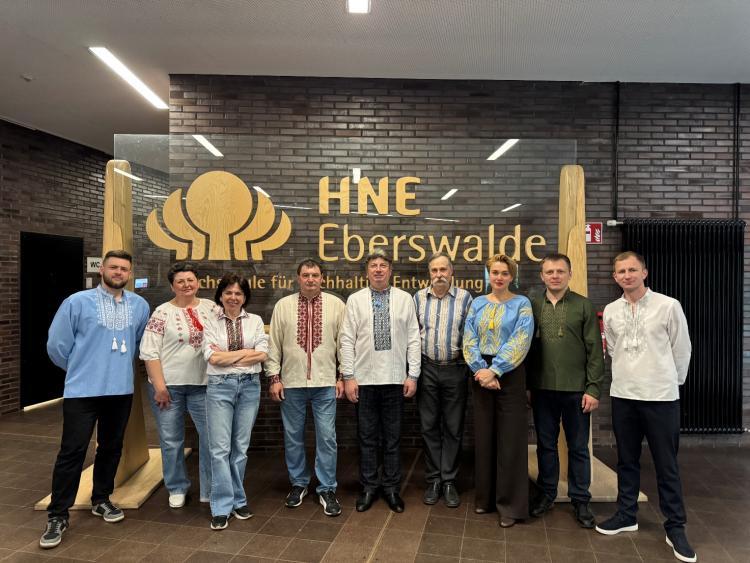
On May 18-22, 2026, representatives of the Educational and Scientific Institute of Forestry and Horticulture of NUBiP of Ukraine together with colleagues from the National Forestry Engineering University of Ukraine (NFEU of Ukraine, Lviv) and the State Biotechnological University (SBU, Kharkiv) worked at the University of Sustainable Development, Eberswalde (Hochschule für nachhaltige Entwicklung Eberswalde, HNEE, Germany). The visit took place within the framework of the Erasmus+ project «Modernizing Master Programs to Support Forest Sector Transformation towards Ukraine's Post-War Green Rebuilding – ForestPost» (grant agreement No.101179074).
The program of the visit focused on the development of two master's courses for students of specialty 205 «Forestry»: «Forest Ecosystem Services» and «Close-to-Nature and Climate-Smart Silviculture». Senior lecturer of the department of forest taxation and forest management Evheniy KHAN took part in the visit from NUBIP of Ukraine,as well as an associate professor of the forestry department Oleksandr SOSHENSKY and a graduate student of the same department Evhen KALCHUK.
Training courses are developed jointly with scientists of the National Forestry Engineering University of Ukraine (Lviv): professor Vasyl LAVNY, associate professor Oksana MYKHAILIV, professor Leonid OSADCHUK and a senior lecturer Lyubov KONDRATYUK and the State Biotechnological University (Kharkiv): professor Yuriy KARPETS and professor Volodymyr PASTERNAK from the same university.
University for Sustainable Development in Eberswalde was founded in 1830 and is one of the oldest centers of Forestry Education in Europe. Its four faculties have about 2,300 students, and the campus itself is located near the UNESCO Schorfheide-Horin Biosphere Reserve.
The first day began with the opening speech of Prof. Peter SPATHELF about the course «Forest Landscape Restoration» as an analog of the disciplines developed by Ukrainian colleagues. Further Prof. Vasyl LAVNY presented the report «Forest Disturbances and Restoration in Ukraine», in which he summarized the current challenges to the Ukrainian Forestry — mass drying of pine stands, the spread of bark beetles and military damage to the forest fund. Oleksandr SOSHENSKY in his report «Ukraine in Wartime: Forests and Forestry Science», revealed the state of the forest sector in war conditions.


As part of the practical part of the visit, all participants had an excursion to the forestry department Spechthausen, to demonstrate and discuss approaches to nature-based forestry in northeastern Germany. Here, participants saw mixed multi-tiered stands of Scots pine with beech and oak, which have been gradually transforming monocultural pine stands into mixed stands of different ages for more than thirty years — an approach that is referred to by the German forestry school as Dauerwald.

In parallel with individual events of the program, the ConnectED Learning Camp student event was held in the HNEE classrooms; some lectures and excursions were attended by its participants.
The next day was devoted to wetlands. Prof. Oliver JÄHNICHER conducted a classroom session on «Restoration and Management of Forested and Non-Forested Peatlands». In Brandenburg, more than 90% of peatlands in forests remain drained, and their re-flooding is one of the priorities of the Earth's climate policy: it is peatlands, not forest stands, that can potentially make the greatest contribution to achieving climate neutrality of land use. In the afternoon, the participants went to a field lesson with the selection of peat cores in a swamp close to the natural state, where they got acquainted with the methods of assessing the thickness of the peat layer, the state of vegetation cover and determining the horizons of peat accumulation.

A separate part of the participants had the opportunity to join the methodical lesson «Digital Analysis of Forest Ecosystems: Point Cloud Fusion» (Stefan REDER and Prof. Jan-Peter MUND). It was about combining spatial data from various sources of remote sensing: photogrammetric point clouds from unmanned aerial vehicles, laser scanning from UAVs and a portable Personal Laser Scanner (PLS).

The cloud from the UAV reproduces the upper canopy well, but the trunks in it are presented fragmentally; instead, the ground scanner captures the details of the trunks, but does not "see" the tops and does not have an external geospatial binding. Combining both data sets allows you to get a full-fledged three-dimensional model of plantings.

The third day was devoted to an excursion to the Horin forestry, the state forests of the state of Brandenburg; the tour was conducted by Prof. Vasyl LAVNY and Prof. Lyubomyr BLASKO. The topic of the tour concerned forestry practices, adaptation of forests to climate change, reformation of pure pine forests in the context of close-to-nature Forestry. At the first location, the forester showed the transformation of an old pine stand into a mixed, mixed-age stand through the creation of understory beech crops. The second location is a stand of white acacia (Robinia pseudoacacia) where invasive cherry (Prunus serotina) has spread; the forester is focusing significant efforts on removing the cherry to restore the second tier of a multi-tiered stand of European beech and sycamore-maple. The group then examined the former swamp, which has been consistently restored to its original state since the 1930s. At the end of the route, the participants visited the Menzies stand of trees of Pseudotsuga menziesii and looked at an example of a logging station where the forester explained approaches to laying skidding drags and removing wood.

The fourth day of the visit was devoted to practical exercises in the forest: Prof. Albrecht OPITZ, Prof. Peter SPATHELF and Prof. Vasyl LAVNY conducted a practical lesson «Thinning». Participants worked on a training site in a pine plantation: using the example of specific trees, approaches to choosing target trees of the future, the intensity and repeatability of care logging, and the width of technological corridors were discussed. Special attention was paid to meta-analyses of recent years, which show that timely liquefaction increases the resistance of plantings to droughts, pests and fires. This directly applies to Ukrainian clean pine forests, which over the past ten years have shown massive outbreaks of drying out – partly due to insufficient intensity of care logging in young plantings.
The final lesson was a lecture by Prof. Peter SPATHELF «Climate-Smart Forestry in Germany». The speaker showed that the positive growth trend in European forests in the 1960s and 1990s was replaced by stagnation and even a decrease in growth, and the drying up of stands after the 2017-2018 droughts was the largest in Central Europe in the last 150 years. Special attention was paid to the weakening of the forest beech, a species that twenty years ago was positioned as the basis of future forests in Europe. Modern research shows that beech shows signs of vulnerability on shallow and dry soils: it is characterized by high hydraulic efficiency, but at the same time low hydraulic safety (tendency to cavitation of the water supply system).

The climate-smart forestry concept complements classic sustainable forestry with two interrelated blocks — climate change mitigation (through carbon retention in the forest, in wood products, and the effect of replacing energy-intensive materials) and adaptation. Among the areas of adaptation Prof. Spathelf highlighted: increasing the functional diversity of plantings — both due to rare native species (linden, hornbeam, smooth elm, sycamore), and thoughtful introduction of non-native species (pseudotsuga, Austrian oak Quercus cerris) subject to the assessment of invasiveness risks; timely logging of care in young plantings with the maintenance of moderate reserves of stem wood; preservation of elements of forests — old trees with microstructures and dead wood in quantities close to 50-60 m3/ha. Separately, the concept of adaptive migration of species (assisted migration) was considered, which makes it possible to equalize the slow natural migration rate of forest species (100-200 m/year) with the rate of climate change.


The visit became an important component of the development of the training courses «Forest Ecosystem Services» and «Close-to-Nature and Climate-Smart Silviculture» and helped to clarify the structure and content of their syllabuses, to form a base of methodological solutions for lectures and field classes, in particular, using marteloscopes and LIDAR technologies, as well as to outline the prospects for including wetlands as an important component of climate policy of land use.
We sincerely thank the project coordinators for the warm welcome and rich program and the international department of NUBiP of Ukraine for organizational support!
Funded By The European Union. The views and opinions expressed belong exclusively to the author(s) and do not necessarily reflect the position of the European Union or the European executive agency for education and culture (EACEA). Neither the European Union nor the funding authority is responsible for their content.