International Rankings

▶ THE World University Rankings
→ NUBiP Ukraine holds the 1501+ position among world universities in the THE World University Rankings and 10th place in Ukraine.
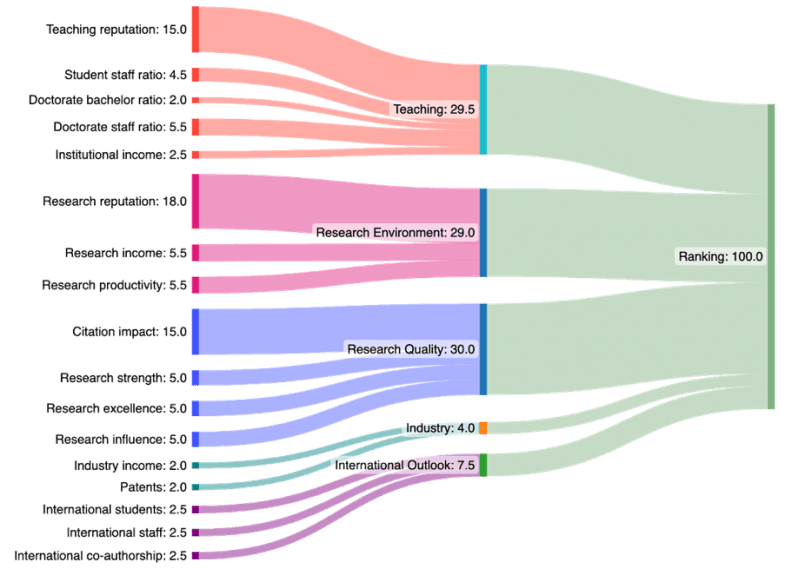
THE WUR provides a list of the world's best universities with an emphasis on research activity. It is the only global university ranking that evaluates research universities across all major areas of their operations using five core pillars:
-
Teaching (learning environment) - 30% of final score
-
Research Environment (volume, income and reputation) - 30%
-
Research Quality (citation impact, research strength, research excellence and research influence) - 32.5%
-
International Outlook (staff, students and research) - 5%
-
Industry (income and patents) - 2.5%
The ranking uses 18 carefully selected performance indicators to provide a more complete and balanced comparison. The overall list is accompanied by 11 subject-specific rankings.
___________________________
▶ THE World University Rankings by subject
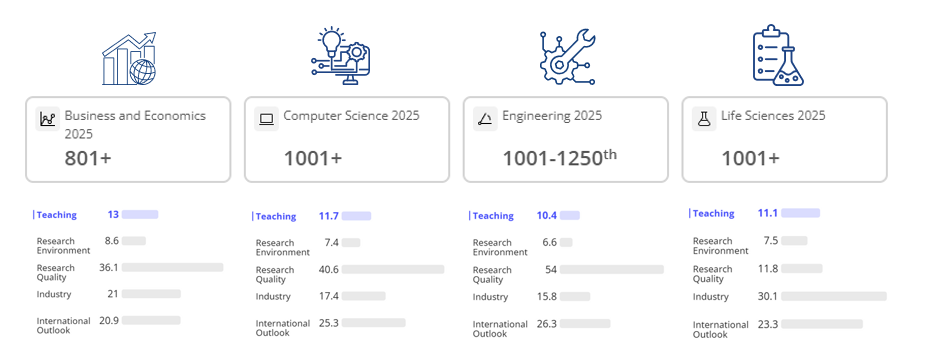
→ Business and Economics: NUBiP ranked 801+ globally, confirming its competitiveness in business and economics. This subject ranking uses adjusted methodology with weightings: Teaching 30.9%, Research 32.6%, Citations 25%, International Outlook 9%, and Industry Income 2.5%.
→ Computer Science: The university achieved 1001+ position, demonstrating significant potential in information technology and cybernetics. Nine Ukrainian universities were ranked in this category.
→ Engineering: NUBiP entered the 1001-1250 group, emphasizing its contribution to developing technical sciences and training qualified engineers for various economic sectors. Eleven Ukrainian institutions were represented in this category. The engineering ranking methodology uses: Teaching 30%, Research 30%, Citations 27.5%, International Outlook 7.5%, and Industry Income 5%.
→ Life Sciences: In the field of natural sciences, the university also received a high evaluation, ranking 1001+ globally, which demonstrates the significant contribution of NUBiP researchers to biology, ecology, and agricultural sciences. This is particularly relevant given NUBiP's specialization in agriculture, forestry, biological sciences, and veterinary science.
___________________________

▶ THE Interdisciplinary Science Rankings 2026
THE Interdisciplinary Science Rankings 2026 Methodology
The ISR methodology consists of a clearly structured system of three pillars representing the research lifecycle, with 11 metrics measuring universities' contributions and commitment to interdisciplinary science.
→ Three-Pillar Structure
Inputs Pillar (19% total weight):
-
Research funding (8%) - Proportion of research income devoted to interdisciplinary science
-
Industry funding (11%) - Industry funding normalized by staff numbers
Process Pillar (16% total weight):
-
Measures of success (4%) - Institutional metrics for interdisciplinary research success
-
Physical facilities (4%) - Specific facilities for interdisciplinary research teams
-
Admin support (4%) - Administrative support for interdisciplinary teams
-
Promotion & Tenure (4%) - Career systems recognizing interdisciplinary research
Outputs Pillar (65% total weight):
-
Number of publications (10%) - Interdisciplinary publications normalized by staff
-
Proportion of publications (5%) - Interdisciplinary publications vs. total science publications
-
Utility of research (5%) - Cross-discipline citation impact (C-score)
-
Quality of research (20%) - Field-Weighted Citation Impact (FWCI) at 75th percentile
-
Reputation (25%) - Reputation for supporting interdisciplinary teams

___________________________

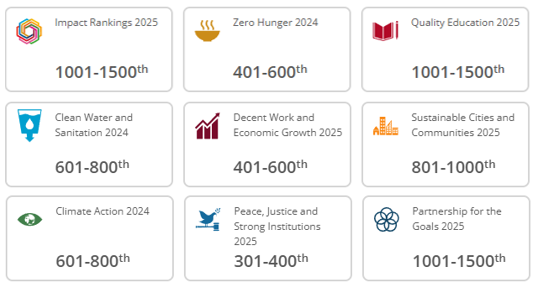
▶ THE Impact Rankings 2025
THE Impact Rankings 2025 evaluate universities based on their contribution to achieving the UN Sustainable Development Goals (SDGs), rather than traditional academic metrics. The ranking measures the implementation of 17 SDGs through university policies, practices, research, and partnerships. For each university, separate scores are calculated for individual SDGs (SDG 1-17), while the overall score is formed as an integrated result across multiple goals (mandatory SDG 17 "Partnership for the Goals" + the best three other SDGs).
Each SDG position is based on a set of several types of indicators:
-
Research – volume and impact of publications related to the corresponding SDG, measuring universities' scholarly contribution to sustainability challenges.
-
Stewardship / Operations – how the university manages its campus, resources, and infrastructure (energy, water, procurement, waste, etc.), demonstrating institutional commitment to sustainable practices.
-
Outreach / Partnership – engagement with local communities, business, government, and international partners to advance sustainable development.
-
Teaching – availability of educational programs, courses, and initiatives that directly support sustainable development goals, ensuring knowledge transfer to future generations.
____________________________________________________________________

▶ QS World University Rankings
→ NUBiP of Ukraine ranks 1401st in the QS World University Rankings 2025 among other higher education institutions worldwide and 11th in Ukraine.
QS WUR - is an annual ranking introduced by the company Quacquarelli Symonds (QS) to evaluate the performance of universities across the globe. It has become one of the most authoritative and widely used university rankings, with the latest edition featuring more than 1,500 institutions from 105 higher education systems.
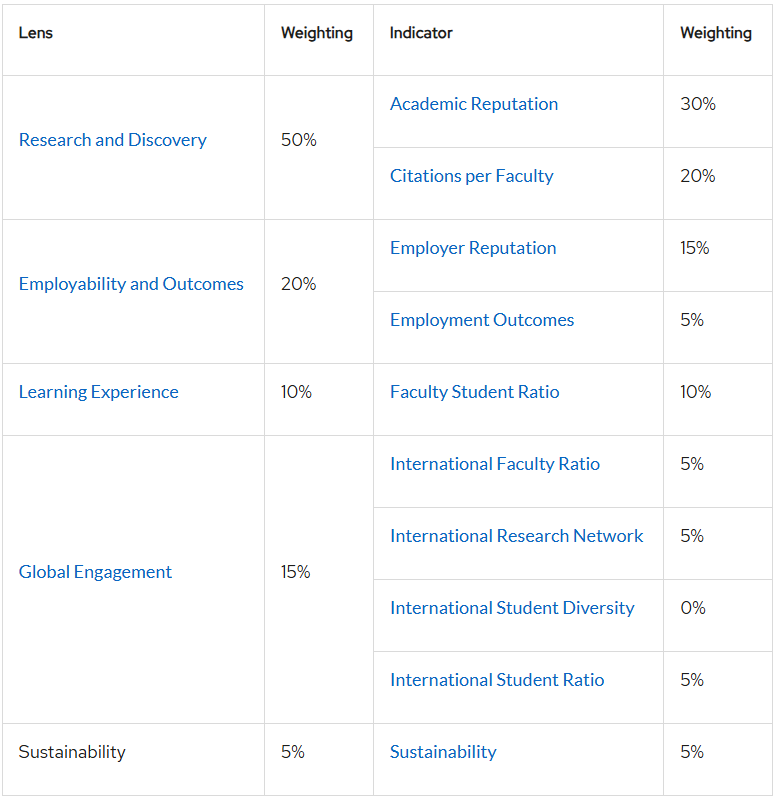
The QS ranking uses eight key indicators to assess universities, which include academic reputation, employer reputation, faculty-to-student ratio, citations per faculty, proportion of international faculty, proportion of international students, employment outcomes, and sustainability. The QS World University Rankings have a significant impact on universities and their stakeholders.
___________________________
→ NUBiP of Ukraine ranks 1501+ in the QS Sustainability Ranking 2026 worldwide and 10th in Ukraine.
QS Sustainability Ranking evaluates universities by their ability to address environmental, social and governance (ESG) challenges rather than traditional academic reputation. The ranking consists of three categories: Environmental Impact, Social Impact and Governance. For the current cycle, almost 2,000 universities worldwide are assessed.
Main indicator blocks
-
Environmental Impact
-
Sustainable institutions: Existence of a sustainability strategy, emissions/energy reporting, membership in climate and “green” networks, student eco‑initiatives, and Net Zero commitments.
-
Sustainable education: Share of programmes/courses on climate and sustainability, reputation and outcomes in earth, environmental and marine sciences.
-
Sustainable research: Volume and impact of research related to environmental SDGs (publications, citations).
-
Social Impact
-
Equality: Gender equality, access, inclusion and support for underrepresented groups.
-
Knowledge exchange: Partnerships with business, government and communities, and knowledge transfer.
-
Educational impact: Contribution to education (SDG 4), pedagogical innovation, teacher training, etc.
-
Employability & opportunities: Graduate employment, employer reputation, internship opportunities.
-
Quality of life: Research and initiatives in health, well‑being, urban environment and related areas.
-
Governance
-
Transparency and public reporting, ethical policies, institutional autonomy and student involvement in decision‑making.
-
Existence of formal sustainability governance mechanisms, leadership accountability and openness of financial data.
_____________________________________________________________________

UI GreenMetric World University Ranking
→ NUBiP of Ukraine ranks 1097th (out of 1745) in the UI GreenMetric World University Ranking and 14th (out of 33) in Ukraine.
UI GreenMetric World University Ranking is an annual ranking of green campuses and environmental sustainability launched by Universitas Indonesia in 2010. It has become one of the tools for assessing universities’ environmental performance worldwide, growing from 95 universities from 35 countries in 2010 to 1,147 universities from 95 countries in the 2024 edition.
The UI GreenMetric ranking is based on the belief that universities play a key role in stakeholders’ and communities’ joint efforts to combat climate change. Its mission is to organise an annual global sustainability ranking, encourage sustainable practices at universities worldwide, provide sustainability‑related services, and foster international partnerships in this field. Universities are evaluated on their efforts to reduce environmental footprint and implement innovative ideas in energy saving, water conservation, waste recycling and green transportation.
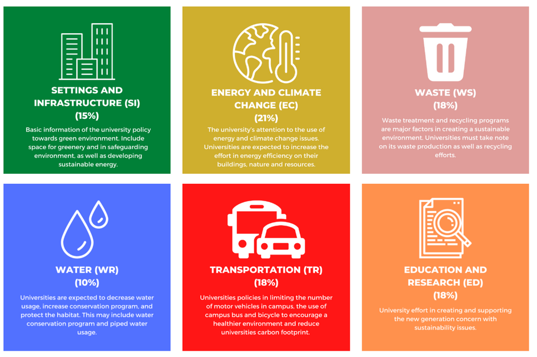
The ranking uses 39 indicators grouped into six key criteria to assess universities:
-
Setting & Infrastructure (SI) – 15%: Ratio of open green spaces to total area, budget for sustainability activities, infrastructure for persons with disabilities, safety and health.
-
Energy & Climate Change (EC) – 21%: Use of energy‑efficient appliances, implementation of smart buildings, renewable energy sources, greenhouse gas reduction programmes, overall carbon footprint.
-
Waste (WS) – 18%: Recycling programmes, reduction of paper and plastic use, treatment of organic, inorganic and toxic waste.
-
Water (WR) – 10%: Water conservation programmes, water recycling, use of water‑saving devices, consumption of treated water.
-
Transportation (TR) – 18%: Ratio of vehicles to campus population, shuttle services, zero‑emission policies, pedestrian pathways.
-
Education & Research (ED) – 18%: Proportion of sustainability‑related courses, funding for sustainability research, scientific publications, student organisations and sustainability‑related start‑ups.