

Internationalisation Strategy
The Internationalization Strategy of NUBiP of Ukraine is implemented within the framework of the development strategy "Holosiivska Initiative – 2030"
DIRECTION 2. INTERNATIONALIZATION OF THE UNIVERSITY AND PROMOTION OF EUROPEAN INTEGRATION
-
Internationalization of higher education today is one of the key factors in improving the quality of education, developing science, and strengthening the competitiveness of universities in the global educational space. It is considered as a purposeful process of integrating international, intercultural, and global dimensions into the mission, governance, educational programs, research, and innovation activities of the University. For Ukraine, internationalization has become an integral component of modernizing the higher education system, integrating into the European Higher Education Area (EHEA) and the European Research Area (ERA), as well as an important tool for post-war recovery and strengthening the resilience of higher education institutions.
-
International and European documents (reports of the European Parliament, OECD recommendations, EHEA initiatives, and Bologna Process decisions) emphasize that internationalization should encompass both physical and virtual mobility, as well as "internationalization at home" through updating educational content, developing intercultural competencies, and using digital technologies. In the Rome and Tirana Communiqués, the ministers of education of EHEA countries outline a vision of an inclusive, innovative, and interconnected European Higher Education Area by 2030, where mobility and internationalization are viewed as tools for improving quality, ensuring accessibility, and promoting sustainable development. At the national level, Ukraine consistently integrates these approaches into state policy, considering internationalization as a component of state strategies for the development of higher education, improving its quality and international recognition.
-
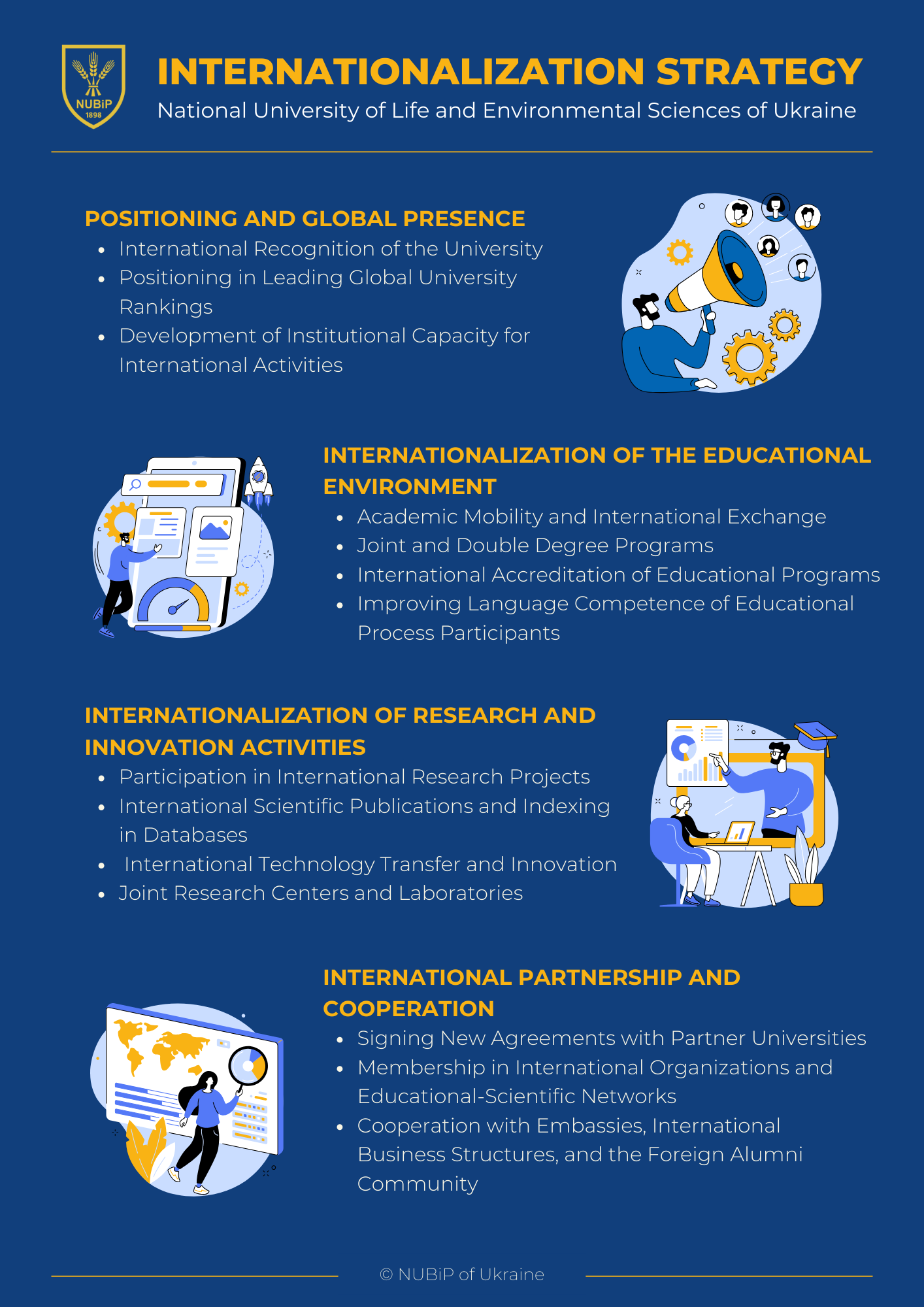
The University's Internationalization Strategy is based on the aforementioned international and national guidelines and specifies them through four interrelated strategic goals: positioning and global presence; internationalization of the educational environment; internationalization of research and innovation activities; international partnership and cooperation. These reflect contemporary directions of internationalization identified by researchers and international organizations: academic (improving the quality of education and research, integrating international standards), economic (strengthening competitiveness, attracting resources), cultural and social (developing intercultural dialogue, civic responsibility, European identity). The proposed operational goals and tasks aim to develop the University's international brand, expand academic mobility, create joint educational programs, integrate into international research projects, develop technology transfer, and build a sustainable network of international partnerships, together with universities, international organizations, business, and the foreign alumni community.
-
The implementation of the strategy involves establishing a clear internationalization management system, developing institutional capacity for international activities, professional staff development, and improving the language competence of students and University employees. An important element is the formation of a quality culture of internationalization through the use of measurable performance indicators, orientation toward principles of academic integrity, inclusiveness, tolerance, respect for human rights and cultural diversity, which corresponds to European approaches to assessing the quality of international activities of higher education institutions. In this way, the University's internationalization strategy becomes a tool not only for formally expanding international contacts but also for the profound transformation of the educational and research environment, aimed at achieving high European standards, strengthening the University's role in the regional and global context, and contributing to Ukraine's sustainable development.
▶▶ STRATEGIC GOAL 2.1. POSITIONING AND GLOBAL PRESENCE
→ Operational Goal 2.1.1. International Recognition of the University
Tasks:
-
Implement planned measures for strategic positioning of the university aimed at enhancing international recognition and building a strong university brand.
-
Introduce an annual plan for international PR campaigns (participation in exhibitions, education fairs, targeted online advertising for international prospective students).
-
Create an English-language version of the university website with up-to-date pages for faculties, programs, research groups, and services for international students.
-
Develop the university's presence on international social media platforms (LinkedIn, Facebook, Instagram, X/Twitter, YouTube) with a systematic English-language content plan, regular publications about scientific achievements, student life, and international projects.
-
Create English-language video content: university promotional videos, virtual campus and research station tours, video interviews with international students and alumni.
→ Operational Goal 2.1.2. Positioning in Leading Global University Rankings
Tasks:
-
Define the list of target international rankings with specified target positions:
-
General rankings (QS World University Rankings, Times Higher Education (THE) World University Rankings, Webometrics Ranking of World Universities, UI GreenMetric World University Ranking)
-
Subject rankings (QS World University Rankings by Subject: Agriculture & Forestry, QS World University Rankings by Subject: Environmental Sciences, THE by Subject: Life Sciences, ARWU (Shanghai Ranking) by Subject: Agricultural Sciences)
-
Thematic rankings (THE Impact Rankings (UN Sustainable Development Goals), THE Young University Rankings (subject to eligibility criteria))
-
-
Conduct benchmarking with comparable agricultural and natural science universities in Ukraine and Europe (Lviv National Agrarian University, Bila Tserkva National Agrarian University, Ukrainian National Forestry University, Czech University of Life Sciences, University of Natural Resources and Life Sciences (BOKU), Warsaw University of Life Sciences, and others) to determine realistic target indicators.
-
Implement an internal system for data collection and verification for rankings: publications in Scopus/Web of Science and their citations; share of international students and academic staff; volume of international research funding; student-to-staff ratio; graduate employment indicators; environmental indicators (for GreenMetric). Assign responsible units and coordinators for work with each ranking.
-
Conduct annual internal audit of indicators affecting ranking positions to make adjustments to annual plans with identification of responsible executors.
-
Integrate ranking indicators into the internal evaluation system for faculties/institutes and departments.
-
Ensure systematic coverage of the university's ranking positions on the official website, social media, and recruitment materials. Use ranking achievements to strengthen the university's international reputation, attract international students, and develop partnerships.
-
Organize information sessions for heads of structural units and academic staff on the methodology of leading rankings, key indicators, and ways to improve them.
→ Operational Goal 2.1.3. Development of Institutional Capacity for International Activities
Tasks:
-
Optimize the distribution of responsibilities and interaction between structural units (International Relations Office, International Projects Office, and International Students Office) and faculties/institutes to ensure comprehensive support for all areas of internationalization.
-
Ensure seamless and synchronized operation of the International Projects Office with all structural units for comprehensive support of project and grant activities (competition monitoring, applicant consulting, administrative support for project implementation, financial reporting, audit preparation).
-
Develop and approve the "Regulation on Implementation of International Projects, Grants and Contracts at the National University of Life and Environmental Sciences of Ukraine."
-
Ensure adequate staffing of the International Activities Centre units in accordance with the volume of tasks and strategic priorities of the university.
-
Implement a system of regular professional development for international activities staff: trainings on preparing project applications (Horizon Europe, Erasmus+, COST, DAAD, Visegrad Fund, etc.), grant management, mobility organization, and intercultural competence development.
-
Provide opportunities for improving English language proficiency (to B2/C1 level) for heads and staff of units involved in international activities: corporate courses, compensation for international certification, language internships.
-
Introduce a mentorship system where experienced international project participants provide consulting support to beginner colleagues.
-
Introduce a system of material and non-material incentives for participation in international activities (bonuses for successful submission and implementation of international projects, additional points in academic staff rating for publications with international co-authors and participation in mobility programs; teaching load reduction for international project coordinators during their active implementation period).
-
Create an internal information system (database, electronic mailing, messenger groups, etc.) for prompt notification of academic staff and students about international competitions, grants, scholarships, and mobility opportunities.
-
Ensure regular information events (seminars, webinars, information days) on opportunities to participate in international programs and specifics of preparing and submitting applications.
▶▶ STRATEGIC GOAL 2.2. INTERNATIONALIZATION OF THE EDUCATIONAL ENVIRONMENT
→ Operational Goal 2.2.1. Academic Mobility and International Exchange
Tasks:
-
Develop the partner network: deepen cooperation with partner universities within concluded agreements and conclude new and update existing mobility agreements (Erasmus+, bilateral agreements) with key partner universities, ensuring balanced geographical coverage (EU, North America, Asia); expand the university's participation in Erasmus+ KA131 (mobility within programme countries) and KA171 (mobility with partner countries) programs.
-
Systematically compile and publicize mobility opportunities for students, PhD candidates, academic staff, and administrative personnel, specifying deadlines, requirements, and funding conditions.
-
Provide comprehensive support for mobility participants before departure (information sessions, language and intercultural preparation), during mobility (coordination with host institution, prompt communication), after return (recognition of results, experience integration).
-
Implement a transparent competitive selection procedure for mobility participants with clear evaluation and selection criteria.
-
Develop virtual mobility programs: joint online courses, COIL projects (Collaborative Online International Learning), virtual exchanges with partner universities.
→ Operational Goal 2.2.2. Joint and Double Degree Programs
Tasks:
-
Identify priority educational programs and international partners for developing joint/double degree programs at bachelor's, master's, and PhD levels.
-
Develop joint curricula (with determination of ECTS credit distribution between partners; mechanisms for mutual recognition of learning outcomes; admission requirements and selection criteria; language of instruction and language requirements).
-
Organize promotional campaigns for joint/double degree programs for Ukrainian and international prospective students.
-
Implement a quality and effectiveness monitoring system for joint/double degree programs: tracking student performance, graduate employment, participant satisfaction.
→ Operational Goal 2.2.3. International Accreditation of Educational Programs
Tasks:
-
Identify priority educational programs for international accreditation considering NUBiP profile, international demand, and available resources.
-
Determine target international accreditation agencies according to subject-specific characteristics of programs: agricultural sciences and food (EAEVE, IFT, ISEKI-Food Association), natural sciences and environment (IUCN, EFMD/EPAS), engineering and technical (EUR-ACE, ASIIN (for engineering and natural sciences), universal agencies (FIBAA, ACQUIN, AQAS), and others.
-
Conduct gap analysis between target accreditation agency requirements and current educational programs (curricula, learning outcomes, staffing, material resources, quality assurance system, etc.).
-
Develop and approve program improvement plans with identification of specific measures, timelines, responsible persons, and necessary resources.
-
Ensure professional development of academic staff and administrative personnel on international accreditation requirements and documentation preparation. Support preparation of reports according to accreditation agency requirements and expert visits.
→ Operational Goal 2.2.4. Improving Language Competence of Educational Process Participants
Tasks:
-
Organize systematic foreign language courses (primarily English) for students of all higher education levels with differentiation by initial level (A2–B1, B1–B2, B2–C1).
-
Introduce requirements for minimum English language proficiency at B1 level for master's students upon completion of studies and B2 for PhD candidates, B2 level for academic staff teaching disciplines in English.
-
Increase the share of academic disciplines taught in English in priority educational programs.
-
Stimulate academic staff to improve language competence and obtain international language certificates (IELTS, TOEFL, Cambridge) by providing preference in mobility selection, bonuses or supplements for teaching in English.
▶▶ STRATEGIC GOAL 2.3. INTERNATIONALIZATION OF RESEARCH AND INNOVATION ACTIVITIES
→ Operational Goal 2.3.1. Participation in International Research Projects
Tasks:
-
Form a list of priority international programs according to the university profile: EU programs (Horizon Europe, LIFE, Digital Europe Programme, Erasmus+, COST Actions, Marie Skłodowska-Curie Actions (MSCA)), regional and bilateral programs (Interreg NEXT, Visegrad Fund, DAAD, Swiss programs SNSF, SDC, and others), as well as international organization programs (FAO, CGIAR, IUFRO, UNEP), and others.
-
Develop an institutional strategy for participation in Horizon Europe with identification of priority thematic areas, target project types, and roles (coordinator/partner).
-
Conduct regular trainings on project proposal preparation for academic staff and researchers.
-
Create a mentorship system and pre-review of project proposals involving experienced grant recipients and external experts.
-
Ensure access to information resources: Funding & Tenders Portal, CORDIS, successful proposal databases, thematic newsletters.
-
Encourage creation of international consortia with leading universities and research organizations.
-
Introduce an incentive system for successful grant funding attraction through bonuses, workload reduction for project managers, inclusion in academic staff rating.
-
Develop cooperation with National Contact Points (NCP) of Ukraine and partner countries to search for opportunities and partners.
-
Provide administrative and financial support for project implementation, including legal expertise of contracts, accounting, reporting.
→ Operational Goal 2.3.2. International Scientific Publications and Indexing in Databases
Tasks:
-
Introduce an institutional publishing policy in journals indexed in Scopus, Web of Science, and other international scientometric databases (including priority for publications in Scopus/Web of Science journals (Q1–Q3), avoidance of predatory journals, affiliation requirements and correct indication of NUBiP, Open Access publishing principles).
-
Provide consulting on journal selection, avoiding predatory journals, preparing and formatting manuscripts in English, peer review procedures and responses to reviewers, publishing ethics and plagiarism prevention.
-
Ensure registration and updating of academic staff profiles in international identification systems: ORCID, Scopus Author ID, Web of Science ResearcherID.
-
Create an incentive system for publications in Q1–Q2 journals (bonuses, academic staff rating increase).
→ Operational Goal 2.3.3. International Technology Transfer and Innovation
Tasks:
-
Develop institutional intellectual property management policy in accordance with EU recommendations (Code of Practice on the management of intellectual assets).
-
Create a technology transfer mechanism focusing on patenting and intellectual property protection at international level, searching for international partners for commercialization, supporting licensing agreements and spin-off companies.
-
Ensure university participation in international innovation exhibitions, technology fairs, and brokerage events (Agritechnica (Germany), SIMA (France), EIT Food events, Enterprise Europe Network (EEN) brokerage events, etc.).
-
Promote NUBiP patents, know-how, and technologies for licensing to foreign companies and organizations, particularly in areas: seed production, agrotechnologies, bioresource processing, forestry.
-
Conclude scientific and technical cooperation agreements with international agricultural sector companies (Bayer, Syngenta, John Deere, CLAAS, etc.).
-
Engage international business in co-financing research, creating joint laboratories and competence centers.
→ Operational Goal 2.3.4. Joint Research Centers and Laboratories
Tasks:
-
Identify strategic partners for creating joint laboratories and centers.
-
Determine priority thematic areas for joint structures according to NUBiP profile (agrobiotechnology and breeding, food safety and quality, climate-smart agriculture, sustainable forestry and bioeconomy, biodiversity conservation and ecosystem services).
-
Prepare roadmaps for creating joint structures (legal status, financing, management).
-
Integrate NUBiP research stations (Boyarka FES, agrobio stations, etc.) into international research networks and long-term monitoring programs.
-
Attract international grants for laboratory equipment.
-
Develop virtual research infrastructures such as joint databases, cloud computing resources, collaboration platforms.
▶▶ STRATEGIC GOAL 2.4. INTERNATIONAL PARTNERSHIP AND COOPERATION
→ Operational Goal 2.4.1. Signing New Agreements with Partner Universities
Tasks:
-
Develop criteria for selecting priority partner institutions (ranking, research priorities, geography, language requirements).
-
Conduct audit of existing agreements and classify them by activity level as active (regular mobility, joint projects/publications), promising (potential for activation), inactive (no activity for more than 3 years) to form cooperation plans. Develop a procedure for activating "dormant" agreements or their proper termination.
-
Form annual plans for visits/online meetings with potential partners.
-
Ensure coordination between faculties regarding initiating and supporting agreements.
-
Create an online database of agreements with open access for academic staff and students, containing information about the partner, type of agreement (framework agreements, academic mobility agreements, joint/double degree program agreements, research cooperation agreements, staff exchange and internship agreements), validity period, and contact persons.
→ Operational Goal 2.4.2. Membership in International Organizations and Educational-Scientific Networks
Tasks:
-
Active membership in international organizations and educational-scientific networks (for example, within the European University Association (EUA), International Association of Universities (IAU), Association of European Life Science Universities (ICA), thematic networks, etc.), which will contribute to internationalization of academic staff and expansion of scientific and educational cooperation network.
-
Ensure regular participation of university representatives in events of these organizations (conferences, working groups).
-
Nominate NUBiP representatives to governing bodies and working groups of international organizations to increase university visibility.
-
Implement "knowledge transfer" mechanisms from these networks to internal university policies and practices.
→ Operational Goal 2.4.3. Cooperation with Embassies, International Business Structures, and the Foreign Alumni Community
Tasks:
-
Create and regularly update a contact database of embassies and consulates in Ukraine (primarily partner countries), cultural centers and institutes (e.g., British Council, Institut Français, etc.), representations of international organizations (FAO, UNDP, GIZ, Swiss Cooperation Office), business associations relevant to the university.
-
Organize joint events (career days, business forums, cultural events) with participation of embassies and international business.
-
Create a platform/association of international alumni (online community, regular meetings).
-
Engage international alumni as brand ambassadors of the university in their countries.
▶▶ PERFORMANCE INDICATORS FOR ACHIEVING STRATEGIC GOALS OF DIRECTION 2
-
Completeness of English-language website version – 100% of key web pages
-
Number of subscribers on international social networks (LinkedIn, Facebook, Instagram) – +15% annually
-
Number of publications about NUBiP in international media per year – at least 5
-
Entry into global rankings (QS, THE, Webometrics) – Top 1501
-
Participation in THE Impact Rankings – at least 3 SDGs
-
Share of academic staff involved in international activities – at least 10% of total staff
-
Number of academic staff who completed trainings on international grants/projects per year – at least 100
-
Number of outgoing student mobilities per year – +5% annually
-
Number of academic staff mobilities (teaching + training) per year – at least 35
-
Number of active academic mobility agreements – at least 50
-
Number of operating joint/double degree programs – at least 5
-
Number of educational programs with international accreditation – at least 3
-
Number of educational programs available in English – at least 1 per faculty/institute
-
Number of disciplines taught in English – +10%
-
Number of submitted international project applications – at least 100 applications per year
-
Number of awarded international projects per year – at least 5
-
Number of awarded Horizon Europe projects – at least 2
-
Number of Scopus/Web of Science publications per year – at least 1000 per year
-
Number of joint publications with international co-authors per year – +10% annually
-
Number of technology transfer agreements with international partners – at least 1
-
Number of cooperation agreements with international companies – at least 5
-
Number of created joint international research centers/laboratories – at least 2
-
Number of NUBiP research stations integrated into international networks or cooperating with international institutions – at least 2
-
Number of international summer/winter schools per year – at least 2
-
Total number of valid international cooperation agreements – at least 100
-
Number of new agreements per year – at least 10
-
Share of active agreements (with actual mobility/projects/events) – at least 70%
-
Geographical coverage (number of partner countries) – at least 35
-
Membership in specialized agricultural networks (ICA, ELLS, CASEE, IUFRO)
-
Number of joint events with embassies and international business per year – at least 5
-
Number of registered participants in international alumni community – at least 100