
NUBiP of Ukraine strengthens cooperation with universities and analytical centers of Central Asian countries
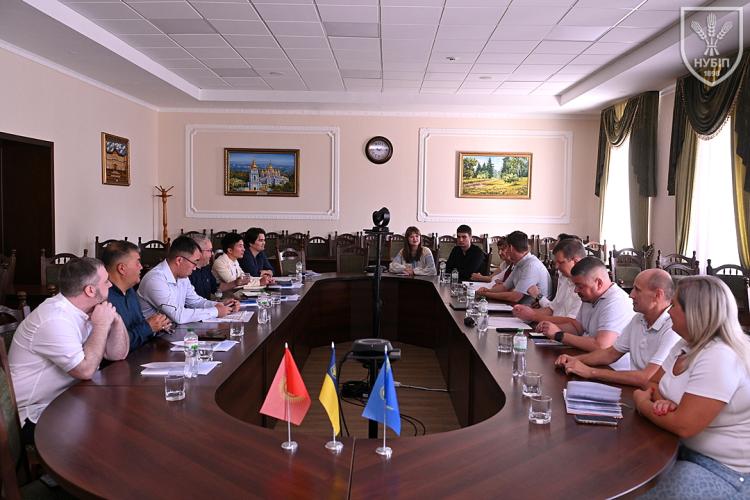
On August 21, 2026, the National University of Life and Environmental Sciences of Ukraine hosted a meeting of the University's management, research and teaching staff with representatives of the academic, expert and public environment of Central Asian countries.
The meeting was held within the framework of the project «Europe and Central Asia: dialogue without borders», which is implemented by the charity organization «International Charitable Foundation for public diplomacy» in partnership with the NGO «Center for Geopolitical Studies "CONSTANTA R&D GROUP"» with the organizational and financial support of the International Renaissance Foundation.
The meeting was attended by the vice-rector for scientific and pedagogical work and international activities as part of representatives of the NUBiP of Ukraine Oleksandr LABENKO, head of the international relations department Maksym KLYMENKO, leading specialist of the international relations department Oleksiy KRAVCHENKO, head of the department of international relations and social sciences Viktoria KHVIST, associate professors Olena KROPYVKO, Iryna MATVIENKO and Bohdan HRUSHETSKY, professor Volodymyr KALUHA.

The delegation of guests was headed by the Director of the International charitable foundation for public diplomacy Fedir LAVRYNENKO. It also includes representatives of the academic and expert community of Kazakhstan and Kyrgyzstan: Nigmet IBADILDIN, Adlet KUMAR, Tlegen KUANDYKOV, Philip NUBEL and Murat KARYPOV.


The central topic of the meeting was expanding systematic cooperation between Ukraine and Central Asian countries in the field of education, science, academic mobility and sustainable development.
During the discussion, special attention was paid to the possibilities of developing the partnership of NUBIP of Ukraine with leading universities in Central Asia, in particular by concluding and updating bilateral cooperation agreements.
Among the promising areas of interaction are identified:
-
initiation of joint educational programs and double degree programs, short-term courses, summer and winter schools, certificate programs, guest lectures;
-
development of professional development programs in the following areas: agricultural sciences, food security, ecology, biotechnology, veterinary medicine and natural resource management;
-
extension of academic mobility of students, postgraduates and research and teaching staff and the establishment of appropriate scholarship programs;
-
implementation of joint research projects and attracting partners to international grant programs;
-
cooperation in the following areas: sustainable agriculture, climate change adaptation, effective land and water management, environmental protection and food security;
-
exchange of experience and formation of joint approaches to post-war restoration of the agricultural sector of Ukraine;
-
strengthening international promotion of educational opportunities of NUBIP of Ukraine and attracting applicants from Central Asian countries;
-
creation of long-term platforms of interaction between Ukrainian and Central Asian scientific institutions in the following areas: agricultural innovations, bioeconomics, rural development, environmental safety and sustainable nature management.
Of special significance for NUBiP of Ukraine is the development of academic and scientific diplomacy, after all, the university has a strong educational and research potential in the fields of agricultural sciences, nature management, ecology, biotechnology, veterinary medicine, forestry and water management.
The meeting participants noted that deepening contacts with scientific and educational institutions in Central Asia opens up new opportunities for international mobility, joint research, exchange of expert knowledge and formation of new educational partnerships.
As a result of the discussion, a wide range of areas were identified that can become the basis for new bilateral and multilateral partnerships of NUBiP of Ukraine with universities, scientific institutions and expert organizations in Central Asia. This is not only about concluding and updating cooperation agreements, but also about their practical content through joint educational programs, academic mobility, research projects, summer and winter schools, professional courses, scientific events and international grant initiatives.
Interaction with representatives of the expert and analytical environment of Central Asia opens up opportunities for deepening regional research and expert dialogue. For NUBiP of Ukraine, this is a promising area for the development of scientific research on international cooperation, agricultural diplomacy, food security, sustainable development and features of socio-economic processes in the Central Asian states.
An important promising result may be the creation of the permanent platform of Ukrainian-Central Asian academic cooperation, which would unite universities, scientific institutions, analytical centers and public organizations. This format will allow not to limit cooperation to individual meetings, but to ensure regular exchange of knowledge, joint development of project ideas, search for international funding and implementation of long-term initiatives.
For NUBiP of Ukraine, deepening ties with Central Asia is also an opportunity to expand the geography of international partnership and strengthen the role of the university as a center of expertise in agricultural education, science, nature management and sustainable development. At the same time, for partners from Central Asia, cooperation with NUBIP of Ukraine opens up access to Ukrainian experience, academic resources, scientific infrastructure and international educational networks.


For the department of international relations and social sciences, such interaction is also important in the context of developing the research and educational projects related to international cooperation between Ukraine and Central Asian states. Additional opportunities for developing the international scientific partnership, involvement of students and young researchers in international projects, expansion of regional studios and practical study of modern mechanisms of academic diplomacy, etc., are also being created.
So, the meeting demonstrated that education, science and public diplomacy could become practical tools for deepening mutual understanding and forming new ties between Ukraine and Central Asia. The next step should be to turn the agreements reached into concrete joint projects — from bilateral agreements and academic exchanges to joint research, educational programs and international grant initiatives.
Thus, the initiated dialogue has the potential to develop into sustainable network of Ukrainian-central Asian Educational, Scientific and expert partnerships this will contribute not only to the internationalization of the NUBIP of Ukraine, but also to the formation of new horizons for cooperation between Ukraine and the Central Asian states.