
Improvement of scientific and pedagogical skills during the international internship «Features of the Finnish education system»
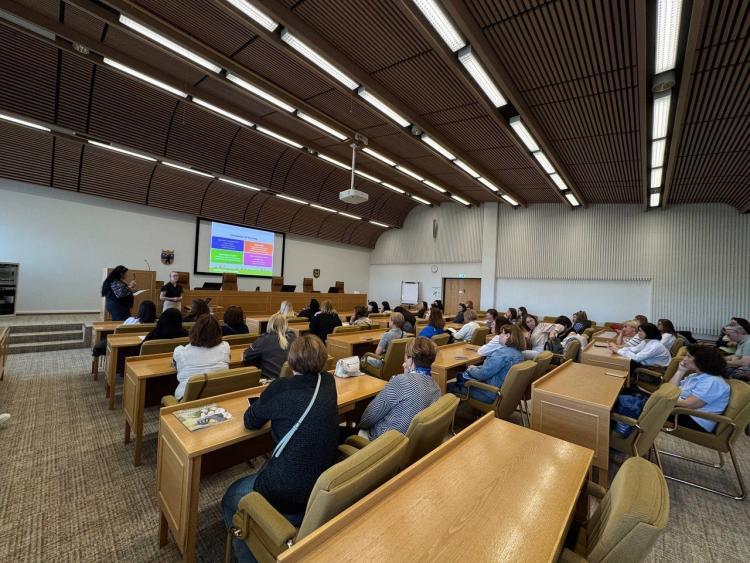
Within the framework of the international scientific internship «Peculiarities of the Finnish education system», which was organized with the support of the Ukrainian-Polish foundation «Institute of International Academic and Scientific Cooperation» on May 16-24, 2026, a group of scientific and pedagogical workers of the National University of Life and Environmental Sciences of Ukraine took an active part.
The group includes associate professors of the department of ecology of the agrosphere and environmental control Olena NAUMOVSKA, Vita STROKAL, Svitlana PALAMARCHUK, professor of the department of physical culture and sports Natalia TERENTYEVA and associate professor of the department of marketing and international trade Olena MOSKVICHOVA.
The internship program included visits to educational institutions of different levels and in different directions, studying teaching systems, presentation of material, forms and methods of communication, attending lectures, thematic seminars and management institutions.
The first day of the internship began with a visit to West Finland College in Kokemyaki, where we got acquainted with the methodology of integrating "game exercises" in learning, the principles of developing the independence of the younger generation, creating a safe and inclusive educational environment for them. The second part of the day included a visit to the City Hall of in the city of Guittinen, meeting with Eija Mattila, head of education department. During the active discussion, we got acquainted with the peculiarities of municipal education management in Finland, the principles of autonomy of educational institutions, strategic planning and cooperation between educational institutions and the local community.

The next day included a visit to the University of Applied Sciences (Tampere), where we studied practice-oriented learning models, principles of integration of Finnish education with the labor market, got acquainted with international educational programs and modern approaches to training higher education specialists in Finland.


The third day of the internship began with an introduction to gymnasium education at the Euran Lukio high school (the city of Eura). The school director spoke about the individual educational trajectory of students, academic autonomy, the principles of supporting educational motivation that they implement in school, and also showed the educational space of the institution. We continued our tour to Turku, the historical capital and one of the most important cultural and educational centers of the country.

The fourth day of the internship was no less intense, and it began with an educational visit to the Meri-Porin yhtenäiskoulu secondary school in Pori. A fairly productive, creative and motivational team of the school showed us the Finnish model "comprehensive school", spoke about the main advantages of intersubject training implemented in them, showed digital educational tools of support practice for Inclusive Learning. After attending the school, we had the opportunity to visit his city and the coastal areas that are washed by the Gulf of Bothnia. The second part of the day had a more practical aspect. In particular, on the basis of the West Finnish college, we listened to a lecture by Andrew FERN on topical issues of the educational process and teaching methods in Finland. The lecture continued with a thematic workshop session on professional discussion of key aspects of the Finnish education system and opportunities for its implementation in Ukraine.


On the fifth day of the internship, it became a real practical case. We visited the oldest agricultural university in Finland — NAMC Mustiala (University of Applied Sciences, Mustiala campus) where we were introduced to the content of bachelor's and master's programs, educational trajectories related to organic farming and the introduction of precision farming technologies. The university has been operating since 1840, has about 10,000 students, 1,445 postgraduates, 130 research institutions, and about 760 teaching staff. The most relevant programs at the University are Climate Smart Agriculture and Design Based Education. The latter program provides training for students to solve a specific problem in the environment and in the agricultural sector. The university has about 180 hectares of arable lands and 180 hectares of forests, which are used as a scientific base for practical training. They also have their own animal husbandry (160 cows). During the tour, we had the opportunity to see firsthand practice-oriented model farming management, and get acquainted with modern approaches to agricultural and applied education.


As a result of passing an international scientific internship, it is worth noting that we received quite thorough scientific and pedagogical skills in teaching and using the material in the educational environment, as well as in the development of motivational, communicative and inclusive skills among students. The undoubted advantage of the internship was to gain practical knowledge on the implementation of models "comprehensive school" in education, and a practice-oriented model of farming management.
We would like to thank the organizers of this internship, in particular the Ukrainian-Polish foundation «Institute of International Academic and Scientific Cooperation» for a very excellent, productive and professionally oriented organization of the internship program.