
Leadership Culture in Response to Today’s Challenges: The Department of Management and Educational Technologies Hosted an International Research and Practice Conference
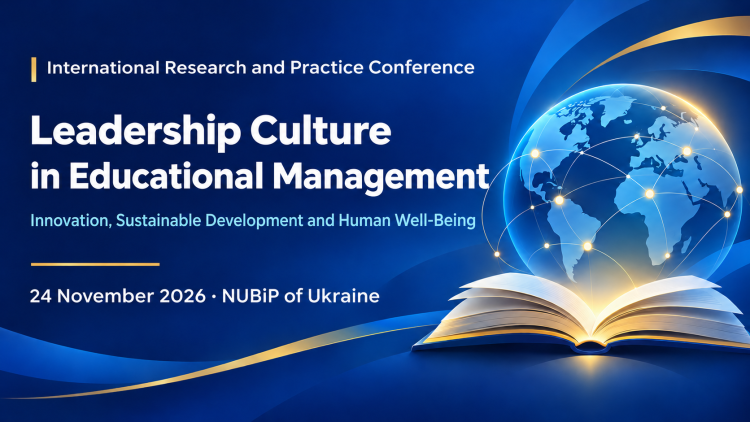
On 24 November 2026, the Department of Management and Educational Technologies of the Faculty of Humanities and Pedagogy at the National University of Life and Environmental Sciences of Ukraine hosted the international scientific and practical conference «Culture of Guidance in Educational Management: Innovation, Sustainable Development, and Human Well-Being». The event brought together researchers, educators, administrators, experts and students from Ukraine, India, Poland, the United States, Norway, Thailand and Uzbekistan. It was held in a hybrid format, with participants joining in person at the university and online via Google Meet.
The conference theme was timely. Against a backdrop of war, demographic losses, digital transformation and the rapid spread of artificial intelligence, education needs more than top-down administration. It needs leaders who guide people through shared values, trust and personal example, look after their teams’ well-being, and take responsibility for educational quality and the sustainable development of their institutions. The participants devoted their discussions to this kind of leadership, which brings together innovation, empathy and accountability.
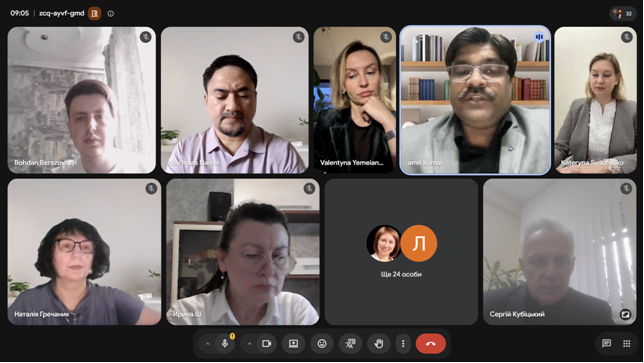
The plenary session was moderated by Amit KUMAR, founder and managing director of AKG Global Support Services (OPC) Private Limited, India. Consecutive interpretation was provided by Bohdan BEREZOVSKYI. This allowed Ukrainian and international participants to engage fully in the discussion across languages.
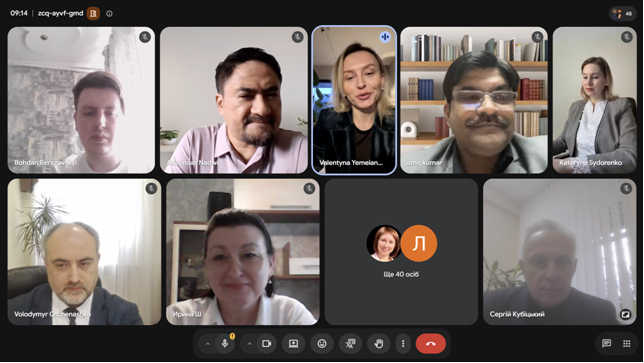
Distinguished guests opened the proceedings with welcoming remarks, highlighting the importance of the conference theme and of international cooperation in education:
-
Amit KUMAR — Founder and Managing Director of AKG Global Support Services (OPC) Private Limited, India.
-
Volodymyr OTCHENASHKO — Doctor of Agricultural Sciences, Professor, Corresponding Member of the National Academy of Agrarian Sciences of Ukraine and Head of the Research Department at NUBiP of Ukraine.
-
Valentina EMELIANENKO — Adviser to the Ukrainian Parliament Commissioner for Human Rights in Norway.
-
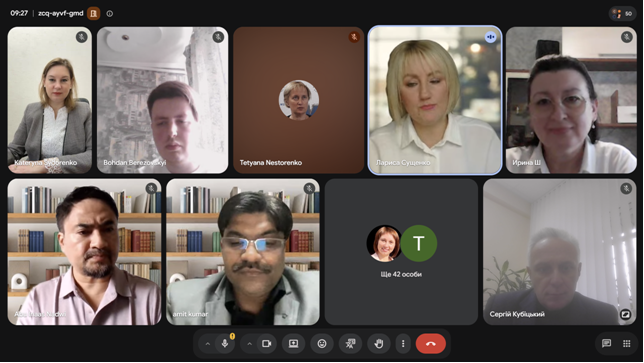
Tetyana NESTORENKO — PhD, Professor at the Academy of Silesia and the Rector’s Representative for Internationalisation, Poland.
-
Kateryna SYDORENKO — PhD, Deputy Director of the Hennadii Udovenko Diplomatic Academy of Ukraine under the Ministry of Foreign Affairs of Ukraine and Academic Dean at New Western University, USA.
-
Larysa SUSHCHENKO — Doctor of Pedagogical Sciences, Professor and Head of the Department of Preschool and Primary Education at Zaporizhzhia National University.
-
Svitlana LUPARENKO — Doctor of Pedagogical Sciences and Professor in the Department of Educology and Innovative Pedagogy at H. S. Skovoroda Kharkiv National Pedagogical University.
-
Fairoz YUPENSUK — CEO of FYP Group Service Co., Ltd., Bangkok, Thailand.
The speakers agreed that people are at the heart of educational quality. A strong academic community, trust, support for teaching staff and openness to international partnerships help universities withstand crises and continue to develop.

Professor Larysa SUSHCHENKO , Doctor of Pedagogical Sciences at Zaporizhzhia National University, opened the plenary session with «Fostering a Culture of Guidance and Unlocking the Professional Potential of Academic Staff through Contemporary Models of Continuing Education». Drawing on the concept of professional capital developed by Andy Hargreaves and Michael Fullan, she showed how educators’ human, social and decisional capital reinforce one another in a culture of guidance supported by flexible continuing education and a strong academic community. She argued that transforming higher education requires a shift from hierarchical administration to values-based leadership.
Professor Maryna DIELINI , Doctor of Economic Sciences in the Department of Production and Investment Management at NUBiP of Ukraine, asked the audience in her presentation «On the Issue of Responsibility in the Era of Digital Transformations» whether the efficiency gains from digitalisation, automation and artificial intelligence always benefit all stakeholders.
Professor Asma FAROOQUI of Integral University in Lucknow, India, argued in her presentation «Emotional Intelligence and Leadership Effectiveness» that educational leadership goes beyond systems, metrics and decisions. At its heart is the shared experience of working and learning together. She explained that trust, adaptability and well-being grow out of everyday interactions between leaders and their teams.

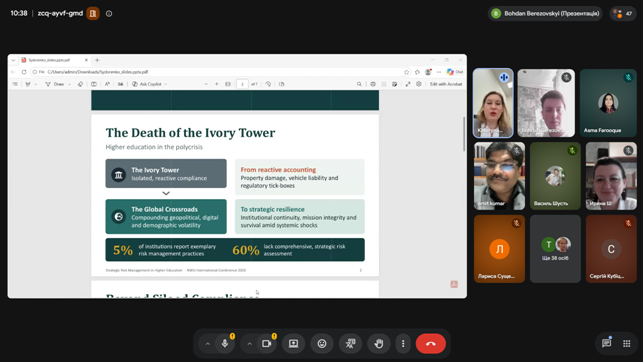
Dr Kateryna SYDORENKO argued in her presentation «Strategic Risk Management in Higher Education Institutions» that the days of the ivory tower were over. Universities face overlapping crises, including cyberattacks and geopolitical and demographic challenges. These pressures call for strategic resilience beyond formal risk-response procedures.

Professor Shobhit GOEL of the Department of Management and Social Sciences at Amity University Tashkent, Uzbekistan, stressed in his presentation «Linking Financial Planning with Institutional Strategy: Building Resilient and Competitive Universities» that financial planning should be a strategic leadership responsibility extending beyond the annual accounting cycle. Researcher Zainab Asif HUSAIN presented «Market Orientation, Competitive Advantage, and Business Performance», putting her point succinctly: listening creates an advantage, and that advantage delivers results.

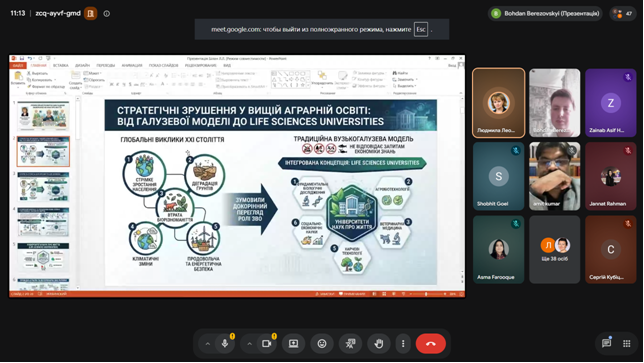
Associate Professor Liudmyla BILAN, Candidate of Pedagogical Sciences in the Department of Management and Educational Technologies at NUBiP of Ukraine, examined in her presentation «Professional Development of Faculty at Universities of Life Sciences in Ukraine» how higher agricultural education is moving from a sector-specific model towards the broader life sciences university model. She outlined areas that will shape the future of education, including agricultural biotechnology, food sciences, ecology and environmental management, the bioeconomy and digital smart farming.
Senior Research Fellow Vasyl SHUST of the Institute of Vocational Education of the National Academy of Educational Sciences of Ukraine opened his presentation «Key Features of University Teachers’ Professional Development as Agents of Educational Quality Assurance in the Contemporary Context» with a simple calculation: 120 hours of professional development over five years amounts to about four minutes a day. His point was that professional development is a daily process that requires guidance on teaching practice, mentoring and peer support.
Associate Professor Maiia KOVALCHUK , Head of the Department of Computer Technologies and Systems Modelling at Polissia National University, gave the presentation «Machine Learning Methods for Multimodal Data Mining», showing how artificial intelligence can support educational management.
The technical session brought a distinctive energy to the conference as early-career researchers and students presented alongside established scholars. Their contributions showed how a culture of guidance is already taking shape among the next generation of educators.
Vinnytsia National Technical University students Inna VOITENKO and Anastasiia KOLODZIISKA showed in their presentation «Human-Centred Leadership as a Factor in Ensuring Well-Being in a Modern Educational Institution» that well-being depends on everyday management decisions about reasonable workloads, support for teaching practice, respect and the quality of working relationships. Their conclusion was that culture changes gradually through leaders’ consistent actions, beyond what directives alone can achieve.

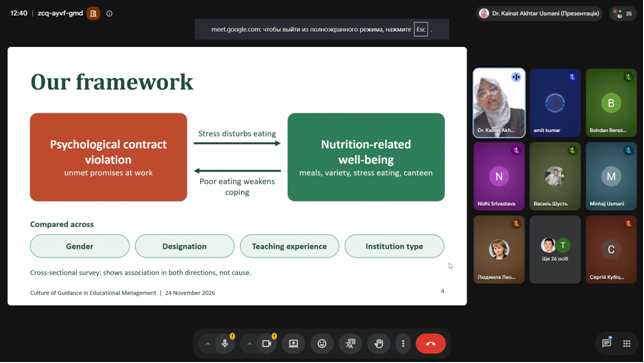
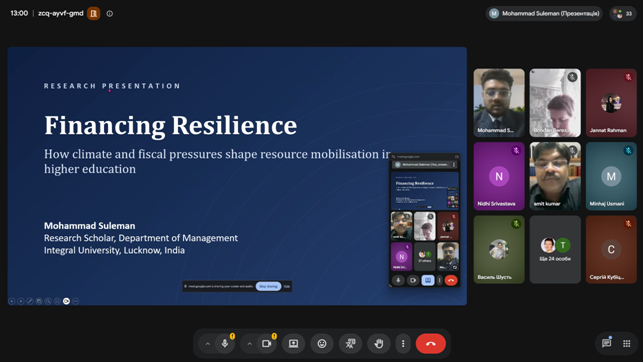
Researchers from Lucknow, India, continued the discussion on educators’ well-being. Dr Minhaj Akhtar USMANI (Era University) proposed a human-centred guidance model titled «Nurturing Minds, Sustaining Educators». Dr Kainat Akhtar USMANI (Integral University), in her presentation «Healthy Plate, Healthy Mind» , examined the relationship between psychological contract breaches and the nutrition-related well-being of academic staff. Researcher Jannat Ara RAHMAN spoke about human resource management practices for academic excellence. Mohammad SULEMAN addressed universities’ financial resilience under climate and budgetary pressures, and Mohd HAMID discussed models of sustainable leadership and guidance in education that strengthen accountability, transparency and institutional performance.
The conference showed how a culture of guidance takes shape in everyday practice through innovation, sustainable development and care for people. Participants discussed how to move from oversight to support, from formal reporting to trust, and from one-off activities to continuous professional growth.
Professor Iryna SHUMILOVA, who initiated and organised the conference, delivered the closing remarks. She summarised the proceedings and stressed the value of international professional dialogue in developing a culture of guidance in Ukrainian education. She expressed particular thanks to Professor Amit KUMAR for his extensive organisational support and significant contribution to the conference, and to Dr Nidhi SHRIVASTAVA, Associate Professor at Amity University, India, for skilfully chairing the technical session. She closed by thanking the speakers, guests and partners for their substantive contributions and for the open, welcoming atmosphere throughout the day.
The Department of Management and Educational Technologies warmly thanks all participants and partners for taking part. We are confident that the ideas and international connections developed at the conference will lead to new joint research and projects.
We look forward to seeing you again!