

Educational and Research Program G3 "Electric Power Engineering, Electrical Engineering, and Electromechanics" – Master's Level
Please note: unless stated otherwise, the documents linked on this page are in Ukrainian.
Programme Guarantor
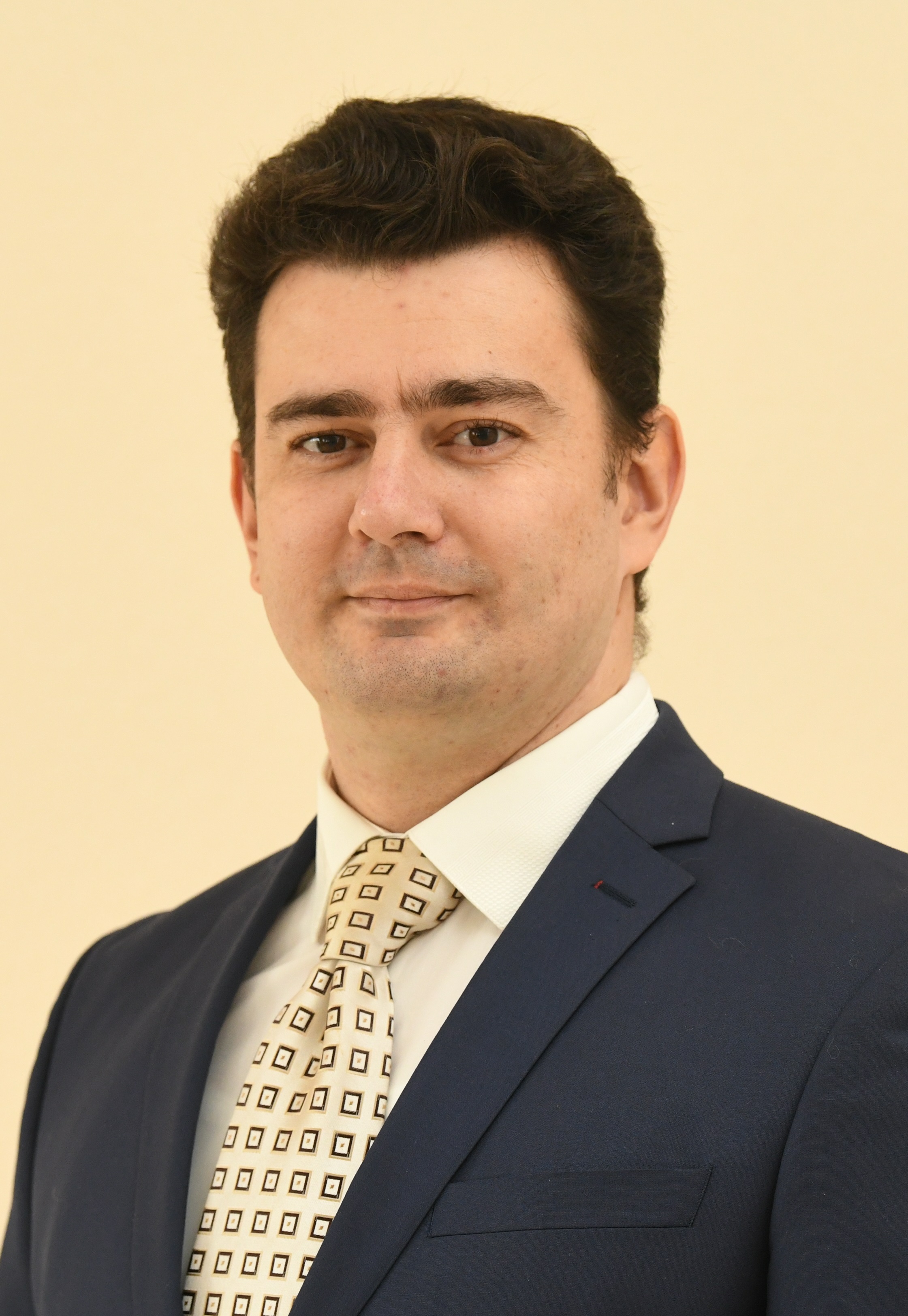
Viktor Trokhaniak
PhD, Associate Professor, Department of Power Systems Engineering
Contact information for feedback and suggestions on improving the programme:
Phone: +380 (44) 527-87-48
E-mail: [email protected]
• Staff page
• Portfolio
• ORCID
• Scopus
• Google Scholar
• Web of Science
Draft educational programme for public discussion
General information about the programme, its development and implementation
Training under the educational and research programme (ERP) “Electrical Power Engineering, Electrical Engineering and Electromechanics” in specialty G3 “Electrical Engineering” is provided by the Educational and Research Institute of Energetics, Automation and Energy Saving (hereinafter – the Institute) of the National University of Life and Environmental Sciences of Ukraine (hereinafter – NULES of Ukraine).
The ERP belongs to the field of study G “Engineering, Manufacturing and Construction”, specialty G3 “Electrical Engineering”, at the second (Master's) level of higher education, level 7 of the National Qualifications Framework. Language of instruction: Ukrainian; duration of study: 1 year 10 months; 120 ECTS credits; mode of study: full-time. Graduate qualification: Master of Electrical Power Engineering, Electrical Engineering and Electromechanics.
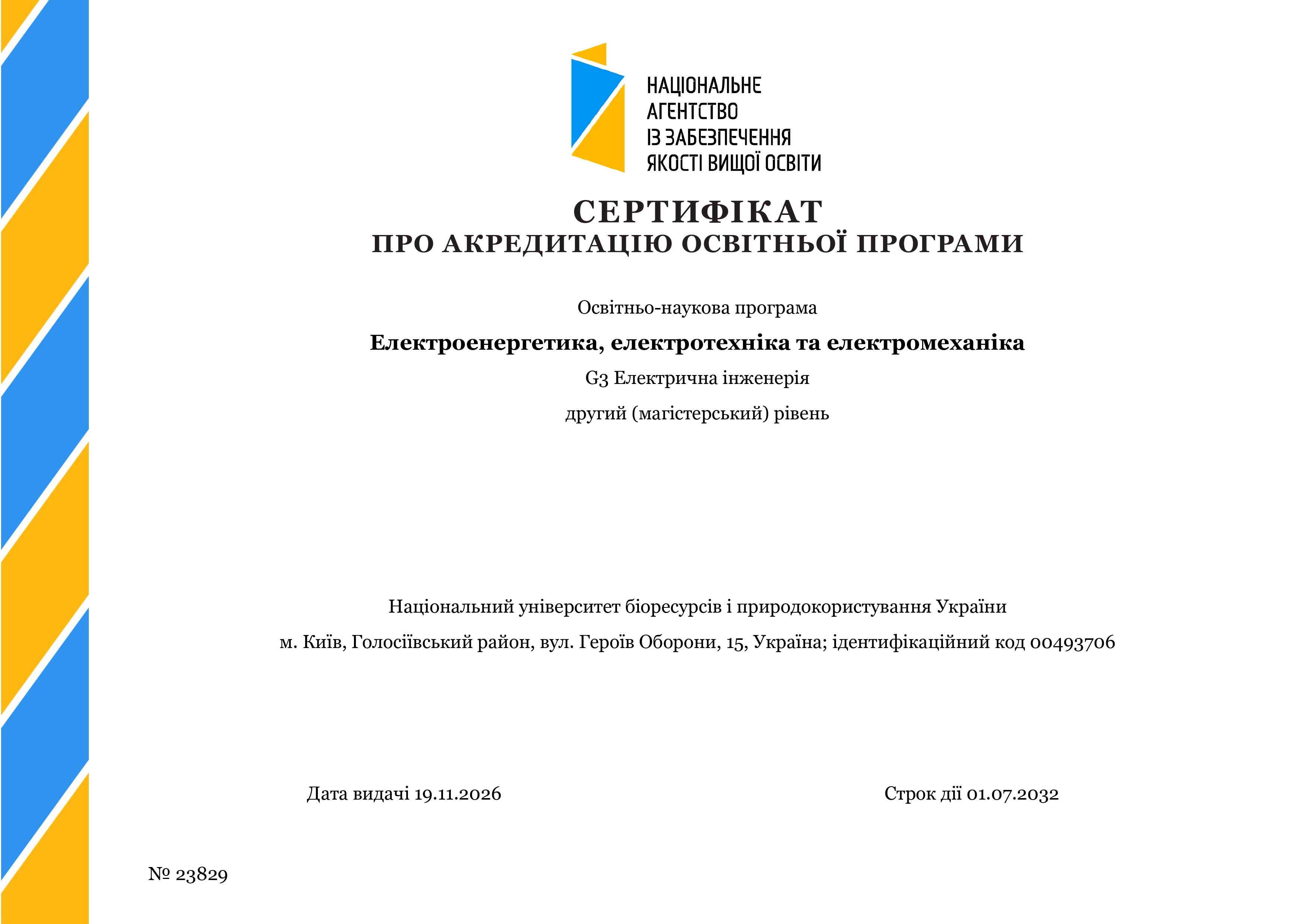
The specialty “Electrical Power Engineering, Electrical Engineering and Electromechanics” at the Master's level was accredited in 2014 (Order of the Ministry of Education and Science of Ukraine No. 2642l of 15.07.2014; accreditation certificate series ND No. 1193075, valid until 1 July 2026).
The ERP was developed by a project group consisting of Viktor Trokhaniak, PhD, Associate Professor (Programme Guarantor); Mykola Zablodskyi, DSc, Professor; Viktoriia Lyktei, PhD; Serhii Usenko, PhD, Associate Professor; and Volodymyr Pavlenko, PhD, Associate Professor. The project group also included an external stakeholder, Svitlana Kovtun, DSc, Senior Researcher, Deputy Director for Research of the General Energy Institute of the National Academy of Sciences of Ukraine, and a student representative, Anastasiia Buzaieva, a first-year Master's student (group EEE-25001M). The composition of the project group was approved by Rector's Orders of NULES of Ukraine No. 1241 of 23.10.2025 and No. 347 of 16.03.2026.
The ERP was developed and is implemented in accordance with regulatory documents, in particular the Law of Ukraine “On Higher Education” and the Regulations on Educational Programmes at the National University of Life and Environmental Sciences of Ukraine. Since the higher education standard for specialty G3 “Electrical Engineering” at the second (Master's) level is still being developed, the programme learning outcomes are defined in line with the level 7 descriptors of the National Qualifications Framework (2025 edition). The transition to specialty code G3 was made in accordance with Resolution of the Cabinet of Ministers of Ukraine No. 1021 of 30.08.2024.
The ERP was approved by the Academic Council of NULES of Ukraine (minutes No. 13 of 21 May 2026) and has been in effect since 1 September 2026.
Programme content
- ERP G3 EEE, Master's degree, 2026
- ERP G3 EEE, Master's degree, 2025
- ERP 141 EEE, Master's degree, 2024.
- Educational programmes of NULES of Ukraine, 2026/2027 academic year
Curricula
Course work programmes: compulsory components
|
Code |
Educational component |
ECTS credits |
Lecturer |
|---|---|---|---|
|
General training cycle |
|||
|
CC1 |
5 |
||
|
CC2 |
5 |
||
|
CC3 |
Methodology and Organization of Scientific Research with the Basics of Intellectual Property |
5 |
|
|
CC4 |
3 |
||
|
CC5 |
3 |
||
|
Special (professional) training cycle |
|||
|
CC6 |
4 |
||
|
CC7 |
4 |
||
|
CC8 |
4 |
||
|
CC9 |
3 |
||
|
CC10 |
Intelligent Control Systems for Electrical Engineering Complexes |
3 |
|
|
CC11 |
4 |
||
|
CC12 |
4 |
||
|
Practical training and attestation |
|||
|
CC13 |
7 |
||
|
CC14 |
10 |
||
|
CC15 |
8 |
– |
|
Elective components (courses)
Students build their individual learning path by freely choosing courses worth 48 ECTS credits, which is 40% of the total programme workload.
University-wide electives (6 ECTS credits). Students choose two courses from the Catalogue of Elective Courses for Second (Master's) Level Students – OCP1 and OCP2, 3 ECTS credits each, assessed by a pass/fail credit test. These courses are taken in the 2nd semester.
Professional electives (42 ECTS credits). Students choose one of two elective blocks: “Electrical Networks and Systems” (OC1.1–OC1.8) or “Electromechanical Devices and Systems” (OC2.1–OC2.8). The block is studied in the 3rd and 4th semesters: four courses of 5 ECTS credits each (20 credits in total) in the 3rd semester and four courses of 6, 6, 5 and 5 ECTS credits (22 credits in total) in the 4th semester. Each course ends with an examination.
Selection procedure. Students make their choice in their personal account in the “My NUBiP” system in accordance with the Procedure for Forming and Selecting Elective Courses at NULES of Ukraine. Before the selection, the graduating department presents the courses and blocks, and descriptions of all courses are published in the Catalogue. University-wide electives are chosen in the 1st semester for the following semester, and the professional block is chosen in the 2nd semester for the second year of study. The choices are recorded in the student's individual study plan.
- Catalogue of educational components of the ERP “Electrical Power Engineering, Electrical Engineering and Electromechanics”, 2026 intake (course descriptions)
- Catalogue of Elective Courses for Second (Master's) Level Students at NULES of Ukraine
- Procedure for Forming and Selecting Elective Courses by Students at NULES of Ukraine (as amended on 26.12.2025)
- Elective courses at NULES of Ukraine
- Results of the selection of university-wide electives by students in previous years
Practical training
Practical training amounts to 17 ECTS credits and is a compulsory part of the programme. It develops professional competences by combining classroom learning with hands-on professional and research work.
CC13 “Industrial Operational Internship” (7 ECTS credits, 7 weeks) takes place at leading companies in the sector, in particular at PrJSC “DTEK Kyiv Electric Networks” (an industry-based branch of the department), where students gain skills in operating digital equipment and in energy management.
CC14 “Research Internship” (10 ECTS credits, 6 weeks) focuses on research and innovation and is carried out in cooperation with the General Energy Institute of the National Academy of Sciences of Ukraine. During the internship, students use artificial intelligence tools for big data analysis and VR/AR technologies for modelling electrical engineering objects.
Final attestation
Graduates are attested through an open public defence of the qualification thesis before the examination board. The qualification thesis involves solving a complex specialised task or a practical problem of a research and/or innovative nature in electrical engineering. All theses are checked for text borrowing and improper use of artificial intelligence and are published in open access in the NULES of Ukraine Digital Library.
- Guidelines for writing the qualification thesis
- Regulations on the Preparation and Defence of the Master's Qualification Thesis at NULES of Ukraine (as amended on 01.10.2025)
- Regulations on Practical Training of Higher Education Students at NULES of Ukraine (as amended on 25.04.2025)
- Topics of qualification theses
- NULES of Ukraine Digital Library
Research component of the programme
The research component of the programme amounts to 36 ECTS credits, or 30% of its total workload, which meets the requirements of Part 5 of Article 5 of the Law of Ukraine “On Higher Education” and the Regulations on the Organisation of the Educational Process at NULES of Ukraine.
|
Code |
Educational component |
ECTS credits |
|---|---|---|
|
CC3 |
Methodology and Organization of Scientific Research with the Basics of Intellectual Property |
5 |
|
CC7 |
4 |
|
|
CC12 |
4 |
|
|
CC14 |
10 |
|
|
CC15 |
8 |
|
|
OC1.1 or OC2.1 |
Technological Structures of Energy Communities (elective block 1), 2027–2028 academic year or Software for Research of Electromechanical Devices (elective block 2), 2027–2028 academic year |
5 |
|
Total research component: 36 ECTS credits, i.e. 30% of the programme workload |
||
The core of the research component is a sequence of compulsory research-oriented components: CC3 “Methodology and Organization of Scientific Research with the Basics of Intellectual Property” → CC14 “Research Internship” → CC15 “Preparation and Defence of the Qualification Thesis”. This ensures a gradual transition from the theoretical study of research methods to independent research and the public defence of its results. The courses CC7 “Mathematical Methods of Modelling in Electrical Engineering” and CC12 “Intelligent Electromechanical Systems” provide the mathematical and computer modelling tools that students apply in their qualification theses.
Regardless of the elective block chosen, each student takes one more research-oriented course worth 5 ECTS credits, which is the first course of each block: OC1.1 “Technological Structures of Energy Communities” in elective block 1 and OC2.1 “Software for Research of Electromechanical Devices” in elective block 2. Both courses develop competences in planning, organising and conducting research (SC3), mathematical and computer modelling of electrical engineering objects (SC6, SC14) and presenting research results (SC15, SC18). Thus, whichever elective block a student chooses, the research component of the programme remains the same – 36 ECTS credits.
Students carry out research within the department's research areas and take part in state-funded and grant projects, in particular the research project “Formation of Technological Structures of Decentralised Energy Systems in the Post-War Reconstruction of the Infrastructure of Territorial Communities in the Context of Counteracting Climate Change” (National Research Foundation of Ukraine, state registration No. 0123U104565 – 2023, 0124U002520 – 2024) and the young scientists' research project “Development of New Heat Power Equipment for an Energy-Saving Microclimate Maintenance System in Poultry and Livestock Buildings” (Ministry of Education and Science of Ukraine, state registration No. 0122U001829, 2022–2024).
Research results are presented at conferences and research seminars of the department and the university and in student research groups, and are published in peer-reviewed professional journals. Graduates of the programme may continue their studies at the third (educational and research) level of higher education to obtain the Doctor of Philosophy (PhD) degree.
- Research areas of the department
- Projects
- Research laboratory
- Conferences
- PhD students of the department
Student research groups
- Energy-Efficient Technologies
- Heat and Mass Transfer Processes in Power Installations and Ventilation Systems
- Diagnostics, Monitoring and Protection Systems for Electrical Equipment
- Inventor – Electrical Engineer
Surveys
Programme partners
- General Energy Institute of the National Academy of Sciences of Ukraine
- Institute of Renewable Energy of the National Academy of Sciences of Ukraine
- Atmosfera LLC
- PrJSC “DTEK Kyiv Electric Networks”
- Svitlotek Trade LLC
- PaverIu LLC
- TVK VEKTOR-VS LLC
- Kernel-Trade LLC
- PrJSC “VENTS”
- PJSC “MHP”
- Tavrida Electric Ukraine LLC
- TBT ENERGO LLC
- PJSC “Cherkasyoblenergo”
- Warsaw University of Life Sciences (Poland) – double degree programme
- Poznań University of Life Sciences (Poland)
- Educational and Research Cluster of Digital Energy
- NGO “Youth Organization of Scientists of Ukraine”
- NGO “Scientific and Technical Union of Power and Electrical Engineers of Ukraine”
Employer feedback and reviews
- Artur Zaporozhets, DSc, Deputy Director for Research and Organisational Work, General Energy Institute of the National Academy of Sciences of Ukraine
- Oleksii Chornyi, DSc, Professor, Department of Automatic Control Systems and Electric Drive, Kremenchuk Mykhailo Ostrohradskyi National University
- List of representatives
Accreditation 2026
- Self-assessment report of the programme
- Order on the appointment of the expert group, G3 EEE, No. 852-E of 08.09.2026
- Schedule of the expert group's online visit
- Open meeting with the NAQA expert group, 22 September 2026, 15:00–15:40 (link)
- Expert group report on the programme
- Conclusion of the Sectoral Expert Council on the programme
Laboratories and specialised classrooms supporting the programme
Department of Power Systems Engineering, Academic Building No. 8
Industry-based branches of the departments
- Department branch at PrJSC “DTEK Kyiv Electric Networks” (memorandum)
- Branch of the educational and research laboratory at Svitlotek Trade LLC (memorandum)
Academic integrity
All qualification theses are checked for signs of academic plagiarism using the StrikePlagiarism system and are examined for improper use of generative artificial intelligence and data fabrication. Students have the right to appeal assessment results through the established appeal procedure.
- Regulations on Academic Integrity at NULES of Ukraine (as amended on 02.09.2026)
- Procedure for Submitting Qualification Theses, Dissertations, Monographs, Articles and Educational Publications for Checking with the StrikePlagiarism System (as amended on 26.02.2026)
- Regulations on the Policy for the Use of Artificial Intelligence at NULES of Ukraine (as amended on 15.08.2024)
- Code of Ethics for Academic Staff of NULES of Ukraine
- Certificates of the programme's teaching staff
- Academic integrity certificates of the project group
Feedback form
Education regulations
Full list of current regulations
- Regulatory documents of the NULES of Ukraine Education Quality Assurance Centre
- Official documents of NULES of Ukraine
Supporting documents on readiness for the academic year
- Extract from the minutes of the Department of Power Systems Engineering meeting No. 10 of 19.09.2026
- Extract from the minutes of the Department of Power Systems Engineering meeting No. 8 of 26.06.2026
- Extract from the minutes of the NULES of Ukraine Academic Council meeting No. 13 of 21.05.2026
- Rector's Order of NULES of Ukraine No. 347 of 16.03.2026
- Rector's Order of NULES of Ukraine No. 1241 of 23.10.2025
News, events, announcements
- Olympiad in “Reliability and Energy Efficiency Management of Electrical Networks” – 2026
- Defence of Master's qualification theses, ERP 141 – 2026
- A second-year Master's student conducted a laboratory class for first-year Master's students – 2026
- Graduation of energy and automation students – 2025
- First orientation meeting of Master's students in power engineering with their curator in the new academic year – 2025
NAQA regulatory documents
- Regulations on the Accreditation of Educational Programmes for the Training of Higher Education Students
- Regulations on the Appeals Chamber of the National Agency for Higher Education Quality Assurance
- Procedure for Scheduling the Acceptance of Applications for Accreditation of Educational Programmes
- Procedure for Issuing, Reissuing, Storing and Recording Certificates of Accreditation of Educational Programmes
- Temporary Procedure for Conducting Accreditation Reviews Using Videoconferencing