
Professional and informational trip of the faculty of land management within the framework of the German-Ukrainian administrative partnership: German experience in managing public lands and prospects for Ukraine
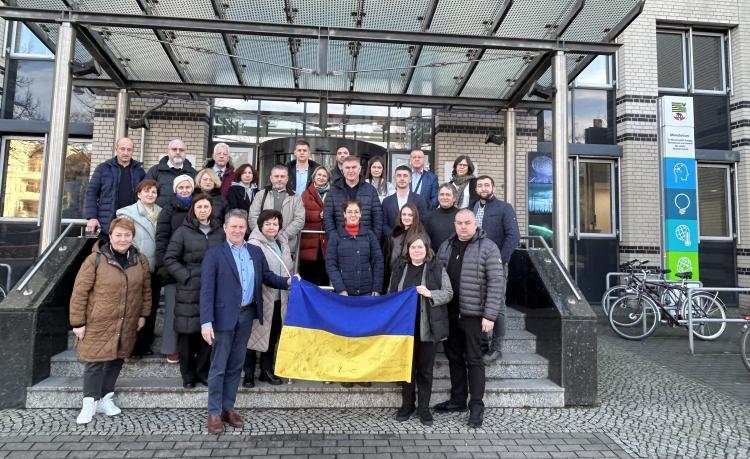
On December 6-12, 2025, a delegation of Ukrainian specialists, which included representatives of the National University of Life and Environmental Sciences of Ukraine, was taking part in a professional and informational trip «German experience in state land management — prospects for Ukraine», held within the framework of the German-Ukrainian administrative partnership. The National University of Life and Environmental Sciences of Ukraine was represented by dean of the faculty of land management Oleksandr SHEVCHENKO and head of the department of land management design Andriy MARTYN.

The working program of the trip included a series of meetings in Berlin and Magdeburg, focusing on land policy and public land management practices, the role of geoinformation infrastructure, anti-corruption approaches and transparency tools, and linking land solutions to spatial planning and community recovery goals.
The key event of the Berlin part was a meeting at the German Federal Ministry of agriculture, food and regional identity (BMLEH), where Andriy MARTYN made a presentation on the current priorities of land reform in Ukraine. In his speech, he outlined the strategic context for the transformation of land relations and noted, «The key goal of the reform is to create a modern, transparent and technologically advanced land management system that is compatible with European law and good governance standards». Separately, he stressed the importance of guaranteeing property rights, strengthening legal certainty and creating predictable conditions for national and international investors.


Dean of the faculty of land management Oleksandr SHEVCHENKO focused on the development of cooperation in education: expanding academic contacts, coordinating the topics of joint educational and scientific-practical initiatives, as well as opportunities to attract German experience in modernizing the training of specialists in land management, cadastre and spatial planning.

In the context of presenting Ukrainian priorities Andriy MARTYN also outlined promising areas for further dialogue and cooperation with German partners and international technical assistance projects: support for digitalization of cadastres and development of LPIS/IACS; strengthening spatial planning at the community level; promoting land consolidation; joint initiatives on ecological restoration of land and development of monitoring systems; development and implementation of modern anti-corruption tools in the field of land relations.

The participants worked out the practical dimension of the German experience during meetings with the federal land management and sales company (BVVG), in particular on the organizational model, lease and sale procedures, the use of IT solutions and geodata in daily operations, approaches to determining the market and rental value of land, contract and property management, as well as the prevention of corruption and the development of compliance practices.


The Magdeburg part of the program focused on practical mechanisms for managing public lands and institutional interaction at the level of the federal state of Saxony-Anhalt. The participants worked with the regional division of BVVG, where they discussed operational approaches to land leases and sales, contract and real estate management, as well as organizational solutions that ensure control, transparency and responsibility in daily activities. A separate element was familiarization with the example of an agricultural enterprise, which allowed us to see how land tools and conditions of use affect production processes and economic sustainability.
Additionally, Magdeburg hosted meetings with relevant institutions in Saxony-Anhalt on land policy in the context of rural development, spatial planning and geodata infrastructure. Approaches to the development and maintenance of a real estate cadastre, geoinformation management and the operation of geoportals, as well as tools for supporting territorial development (in particular, within the framework of LEADER/CLLD) were discussed. The result was a reconciliation of common expectations and fixing areas of further cooperation that can be useful for the Ukrainian practice of land management in the context of restoration and European integration.

The Ukrainian delegation included representatives of government institutions, parliament, relevant departments, scientific institutions and professional associations. The participants of the meetings agreed on further steps of bilateral cooperation in the field of land policy and state land management. Taking into account the European integration agenda of Ukraine and the challenges of recovery, the German experience has demonstrated an example of institutional consistency, technological equipment and high standards of transparency in the field of land use, which is important for building trust, investment attractiveness and good governance.