


Meeting of higher education seekers with Olena KHALIK, editor-in-chief of Novyny.LIVE
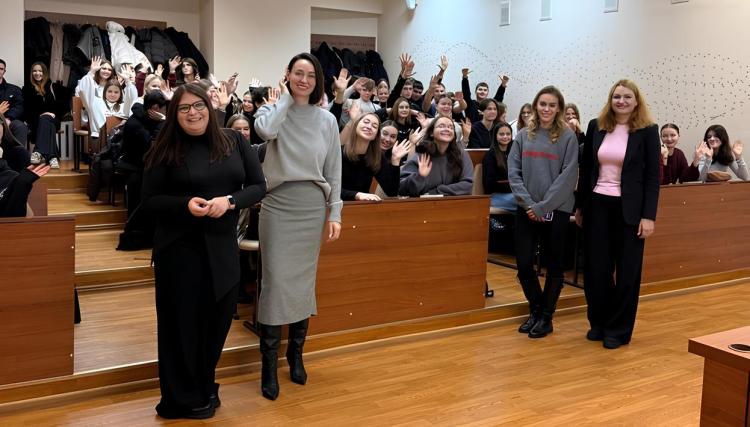
On 3 December 2025, a meeting was held between higher education students, including members of the DNA Leader student research group, and Olena Khalik, editor-in-chief of Novyny.LIVE (Live Media HUB media holding), a journalist with over 20 years of professional experience. The meeting was initiated by Olha TIMCHENKO, Associate Professor of the Department of Management named after Prof. J.S. Zavadsky.

Olena KHALIK has worked for leading Ukrainian TV channels – Ukraine 24, Hromadske, Channel 5, STB, completed an internship at the BBC in London and is a journalism coach. She gave a substantive lecture for higher education students on the topic: ‘How to distinguish facts from fakes and navigate the information noise?’
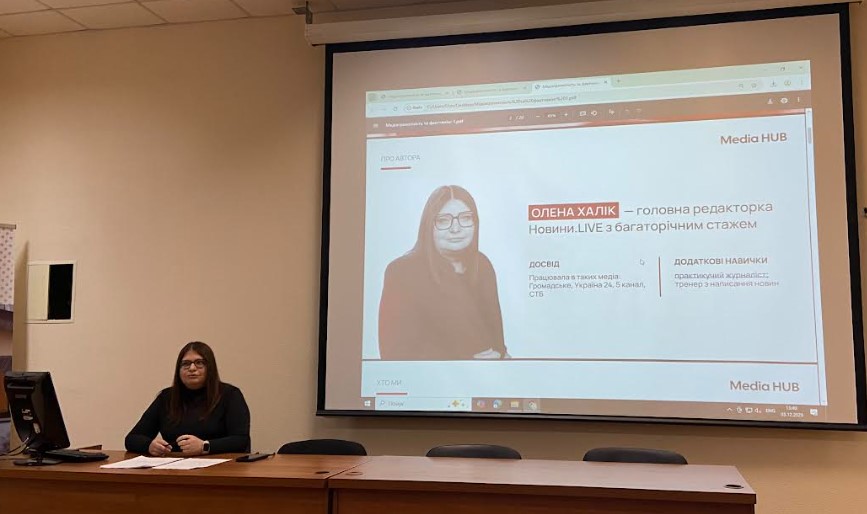
During the meeting, participants gained in-depth knowledge about the key elements of modern information literacy. In particular, Olena Khalik elaborated on the role of media literacy in the context of digital communication, emphasising that today every person is both a consumer and a disseminator of information. The speaker stressed the importance of being aware of news sources, analysing their reliability, and understanding how information flows influence public sentiment.
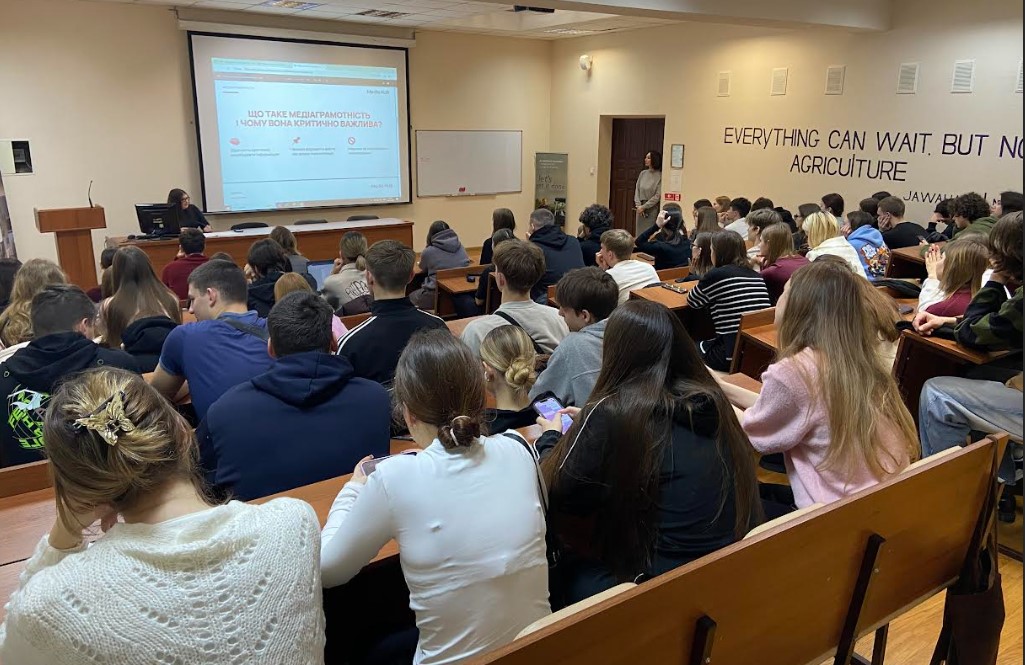
A separate section was devoted to professional fact-checking tools used by journalists to detect manipulation. Students learned about the signs of fake news and manipulative headlines, and examined real-life examples that contained emotional triggers, one-sided interpretations, or deliberate misrepresentations. Based on these cases, the speaker explained how to avoid information traps.

An important element was the discussion of critical thinking, namely how to treat information responsibly before sharing it on social media and messengers. Olena emphasised that information security today depends not only on the media, but also on every citizen. The role of artificial intelligence in the news was also discussed, from automated monitoring of the information space to compiling news digests. The speaker explained the opportunities that AI opens up, but also noted the risks it can pose.
The final block consisted of practical recommendations for quick fact-checking that anyone can apply on a daily basis. The knowledge gained is of great practical importance for higher education students. In the context of information wars, a large volume of news and technological developments, students have been given tools that will help them, in particular defend themselves against disinformation and develop their own information resilience; work correctly with data in educational and scientific projects; consume information consciously and avoid manipulation; improve communication skills in educational and professional environments; prepare to work with the media in future professional activities, regardless of specialisation, etc.

It is worth noting that the students had the opportunity to talk to a practising journalist who works daily with top government officials, politicians and military personnel, which made the meeting particularly valuable and motivating.
We sincerely thank Olena KHALIK for her informative lecture, openness to dialogue and valuable practical advice.