

Internship at the Global Fire Monitoring Center (GFMC) and Study of German Experience for the Restoration of War-Affected Forests in Ukraine

Oleksandr Soshenskyi, Associate Professor at the Department of Silviculture and Head of the International Projects Office of the National University of Life and Environmental Sciences of Ukraine (NUBiP of Ukraine), was on a working visit to the Global Fire Monitoring Center (GFMC) from 26 October to 6 November 2026. The Center operates under the Max Planck Institute for Chemistry and the University of Freiburg (Germany). The visit took place within the project “Forest Risk Management in Areas at High Risk of Forest Fires and in War-Affected Areas (FoRiMa)”. The project is funded by the German Federal Environmental Foundation (Deutsche Bundesstiftung Umwelt, DBU) under the DBU Ukraine Support Initiative (Az. 30025/120-46). The programme of the visit combined a research internship in Freiburg, participation in the German Environmental Prize 2026 award ceremony in Aachen, and a presentation at the 10th International Conference on Forest Fire Research in Coimbra (Portugal).
The FoRiMa project “Risk Management in Areas at High Risk of Forest Fires and in War-Affected Areas” is implemented with the support of the German Federal Environmental Foundation (DBU). Its aim is to increase the resilience of Ukraine’s forests to fires and climate change and to develop approaches to managing forests where, due to the war and contamination with explosive ordnance, conventional fire protection methods have become impossible. The project combines applied research, field surveys and consultations with foresters, analysis of satellite fire monitoring data, and the study of the experience of Germany and other countries in managing contaminated areas.

The visit began with participation in DBU events in Aachen. On 24 October, I took part in a meeting of participants of the DBU Ukraine Support Initiative, and on 25 October I attended the award ceremony of the German Environmental Prize (Deutscher Umweltpreis), which DBU presented for the 34th time. The 2026 prize was shared equally between two laureates (https://www.presseportal.de/pm/6908/6377285). Environmental lawyer Dr Roda Verheyen was honoured for her many years of struggle for climate and environmental justice through legal means. Engineer Dr Klaus Vossenkaul received the prize for developing an innovative membrane filter technology for wastewater treatment and water reuse. The ceremony was attended by the Federal President of Germany, Frank-Walter Steinmeier, who also met with Ukrainian participants of the DBU Initiative.

After Aachen, the visit continued at the Global Fire Monitoring Center (GFMC) in Freiburg. The internship was devoted to German experience in managing forests contaminated with explosive ordnance, integrated fire management in pine forests, and joint work on the results of the FoRiMa project.

Together with Prof. Johann Goldammer, whose collaboration with NUBiP spans two decades and who was awarded an honorary doctorate by our university in 2013, we discussed the interim results of the project, in particular the analysis of fires in Ukraine during the years of the war and the results of field surveys of pine forests in Polissia. Considerable attention was paid to forests that will remain inaccessible for a long time due to contamination. We considered the possibilities of adapting German experience to Ukrainian conditions, in particular prescribed burning in mined areas, which can be combined with demining, limiting the spread of fire, and modern technologies for protecting such forests from fires. One of the most valuable parts of the internship was a field trip to the mountain forest of Schauinsland, part of the Freiburg city forest in the Black Forest. The forest rises from the Günterstal valley by almost 900 m in elevation. As late as the end of the 18th century, a large part of these slopes were pastures and fields; today it is a mixed mountain forest and a nature protection area. Here it is clearly visible that the landscape of Central Europe was shaped by people over centuries, in particular through livestock grazing and the use of fire. The consequences of the droughts of recent years are also visible here.

During the internship, the role of fire as a natural ecological factor was also discussed. Many of Europe’s current protected areas are in fact cultural landscapes shaped over centuries by livestock grazing, biomass harvesting and the use of fire. It is precisely thanks to such disturbances that they have high biodiversity. Therefore, as Prof. Goldammer emphasised, the task is not to prevent all fires, but to manage them.
Another topic of discussion was climate change as a factor that will alter fire regimes over the coming decades. The first signs of such changes appeared in the tropical forests of Indonesia as early as the 1980s, and today they are noticeable in Germany as well. The drought of 2026 depleted the springs and groundwater of the Black Forest. About 80% of Germany’s forests have drought-damaged crowns, including beech forests, and more fires are now recorded in broadleaved stands than in coniferous ones. Prolonged droughts, decreasing precipitation and new extreme weather events increase the risk of fires. It is impossible today to fully predict the consequences of these changes for forests. Therefore, research on the impact of climate on forest ecosystems is becoming a shared task of fire science and silviculture.
Particular attention was paid to the impact of the war. The situation in Ukraine is exceptionally complex, as the country simultaneously faces radioactive contamination after the Chornobyl accident, contamination with explosive ordnance as a result of the war, and the still widespread burning of agricultural residues. Fires from different sources interact, and fire from the combat zone or from fields spreads to forests and protected areas.

The experience of Germany is useful for Ukraine, where forests on the sites of former battles and military training grounds are still contaminated with munitions. The danger does not decrease over time but increases. Munition casings corrode, and in Germany cases of self-ignition of phosphorus munitions during hot summers are already being recorded. Therefore, demining of affected areas after the end of hostilities must receive the highest priority.
At the same time, forests are usually last in the queue for demining, after settlements and infrastructure, and it will not be possible to clear them in the near future. Consequently, forest landscapes require the identification of priority sites for survey and demining, as well as management models for areas that will remain contaminated. Ukraine already has such experience, having managed forests in the Chornobyl Exclusion Zone for decades. This is precisely the approach being built into the strategy being developed within the FoRiMa project.
Professor Goldammer also spoke about the history and development of GFMC, which began with the establishment of the Fire Ecology Research Group at the University of Freiburg in 1979. GFMC was founded in 1998, and later the Global Wildland Fire Network was formed under the auspices of the United Nations. Today, the network brings together 14 regional networks, and its experience is being transferred to the Global Fire Management Hub at FAO. In 2013, REEFMC at NUBiP of Ukraine became one of the first regional centres of the network.

Podcast with Prof. Johann Goldammer: "Fire Regimes in Transition and the Rise of a Global Fire Network"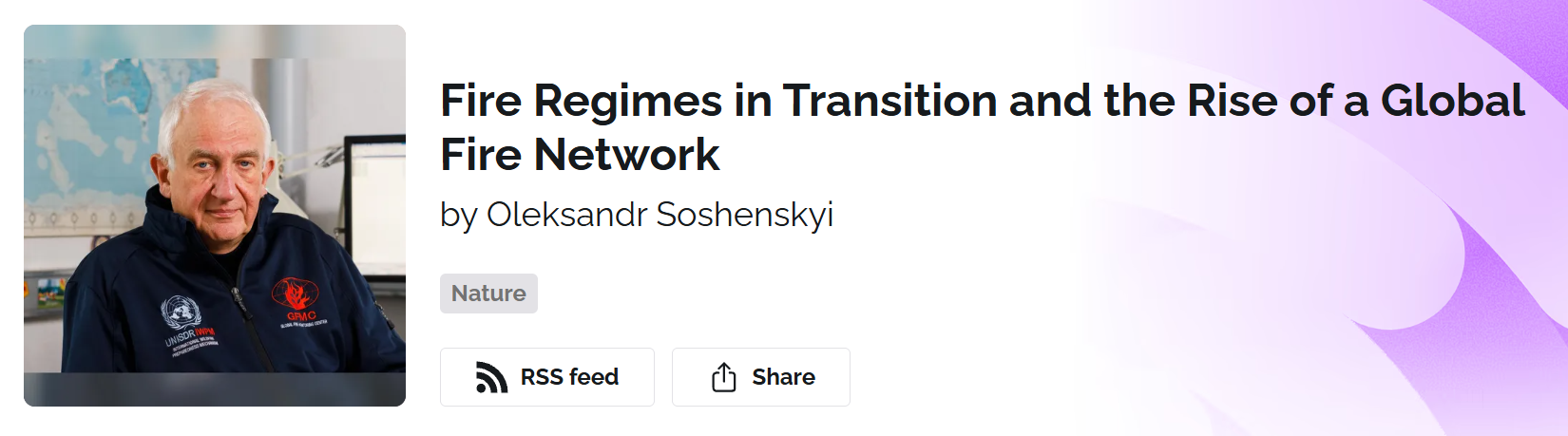
I express my sincere gratitude to the German Federal Environmental Foundation (DBU) for supporting the implementation of the FoRiMa project, which is important for Ukraine, and for the opportunity of this internship. I would also like to thank the team of the DBU Ukraine Support Initiative, in particular Dr Nicole Freyer-Wille, and DBU Secretary General Alexander Bonde. Special thanks go to Prof. Dr Johann Georg Goldammer for his hospitality, the experience he shared, and his many years of support for Ukrainian fire ecology specialists.
The results of the internship confirm that the management of war-affected forests cannot be limited to fire suppression. What is needed is a landscape approach that takes into account the role of fire in ecosystems, long-term climate change and the reality of contaminated areas. The experience gained will be used in the outputs of the FoRiMa project, in particular in the strategy for managing natural landscapes contaminated with explosive ordnance, in the guidelines on fire and fuel management in pine forests, as well as in the training of NUBiP of Ukraine students and in professional development for foresters. Cooperation between NUBiP, REEFMC and GFMC continues, and after the end of the war the partners plan to continue their joint work directly in Ukraine.