


SUMMER SEMINAR (B-LEARNING) WITHIN THE EU_NITRA_UKR PROJECT HAS STARTED
One of the educational activities planned within the EU_NITRA_UKR project is conducting a so-called summer semester, the tasks of which include:
-
Field testing of nitrate content in surface and groundwater, and mapping of nitrate pollution in groundwater for NULES students;
-
Determining the main sources of nitrate pollution in the studied water bodies;
-
Determining measures to prevent pollution based on the approaches of the EU Nitrates Directive.
On April 22, 2026, an ongoing field session took place as part of this educational activity. It was conducted by the project’s leading expert, Candidate of Biological Sciences, Docent Olha KRAVCHENKO, and the project manager, Candidate of Chemical Sciences, Docent Nadiia PROKOPCHUK. It was attended by 21 students of the 13th group of the Agrobiological Faculty of NULES of Ukraine.
A cascade of water bodies located on the territory of the Holosiivskyi National Nature Park and the M. Rylskyi Park, which are fed by small rivers (Nyvka, Liubka, Koturka, Vita), was selected as the objects for the field study. The main water bodies are: the Horikhuvatski ponds (4 artificial ponds), Lake Didorivka, Lake Shaparnia, and the system of Kytaivski ponds.
The excellent weather contributed to a good mood for work, which proceeded in an organized and productive manner. The experimental part of the work covered in situ monitoring of nitrate content using a HORIBA LAQUAtwin NO3-11 nitrate meter. In the laboratory, the testing results were verified using a precise analytical method - photometric determination in the form of a salicylate complex.
The theoretical part of the session was dedicated to considering the question of why monitoring should actually be conducted. The session instructors explained that without this, it is impossible to fulfill the basic requirement of the Nitrates Directive: identifying zones vulnerable to nitrate pollution.
Case Study: Assessing the Horikhuvatka River
The case study of the session consisted of students learning to determine the so-called Strahler order, which is needed for assessing the nitrate status and trends of nitrate pollution spread, using the example of the Horikhuvatka River:
The Horikhuvatka (or Orikhuvatka) River, flowing in the Holosiivskyi district of Kyiv, has a 1st order according to the Strahler classification. The assessment is based on the following hydrographic data:
-
Absence of tributaries: According to cartographic data and hydrological descriptions, Horikhuvatka is an elementary watercourse that has no permanent tributaries of its own. Since it is the "initial" link in the hierarchy, it is assigned the lowest order number.
-
Hydrological status: It is a small river about 4 km long, originating in the Holosiivskyi Forest (near the National Expocenter of Ukraine) and flowing into the Lybid River.
-
Place in the system: Since Horikhuvatka flows into the Lybid (which itself is a tributary of the Dnipro), it is considered a first-order tributary relative to the Lybid, but in the overall Strahler hierarchy, as a stream without tributaries, it remains a 1st-order stream.
How to independently verify the order on a map:
-
Find the river’s source (in the Holosiivskyi Forest).
-
Trace the channel to the point of confluence with another river (Lybid). If no other permanent rivers or streams (having their own sources) flow into the river along its entire path, then its Strahler order is equal to 1.
The methodology for designating zones vulnerable to nitrate pollution involves the following:
-
Surface and/or groundwater used for drinking water supply, or intended to be used as drinking water sources:
-
If an excess of nitrate content (NO3−) of more than 50 mg/dm3 (11.3 mg N-NO3−/dm3) is recorded;
-
In the future, provided no appropriate measures are taken to prevent water pollution, an excess of nitrate content (NO3−) of more than 50 mg/dm3 (mg N-NO3−/dm3) is possible.
-
-
Given the biogeochemical instability of nitrogen compounds in water, to identify zones vulnerable to nitrate (accumulation), the total content of inorganic nitrogen compounds is considered:
Ninorg=NH4+ + NO2− + NO3−.
The criterion Ninorg>11.3 mg N/dm3 is applied to rivers with a Strahler order < 5 and to groundwater.
|
CONCLUSION The conducted field session allowed the students to successfully consolidate their theoretical knowledge regarding the requirements of the EU Nitrates Directive and apply them in practice to identify zones vulnerable to nitrate pollution. The participants mastered a comprehensive approach to water quality monitoring, combining in situ field measurements using modern devices with precise analytical studies in the laboratory. Thanks to the case study, the students learned to analyze hydrographic data and determine the order of watercourses according to the Strahler classification (using the Horikhuvatka River as an example), which is a basic condition for correctly assessing the nitrate status of surface waters. |
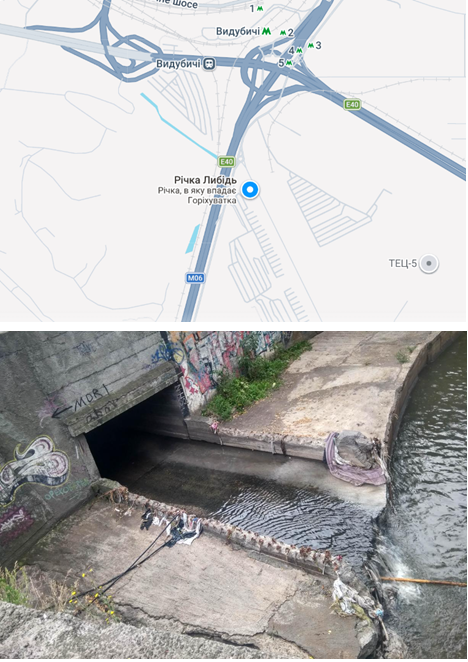
The confluence of the Horikhuvatka River into the Lybid River near the “Vydubychi” metro station
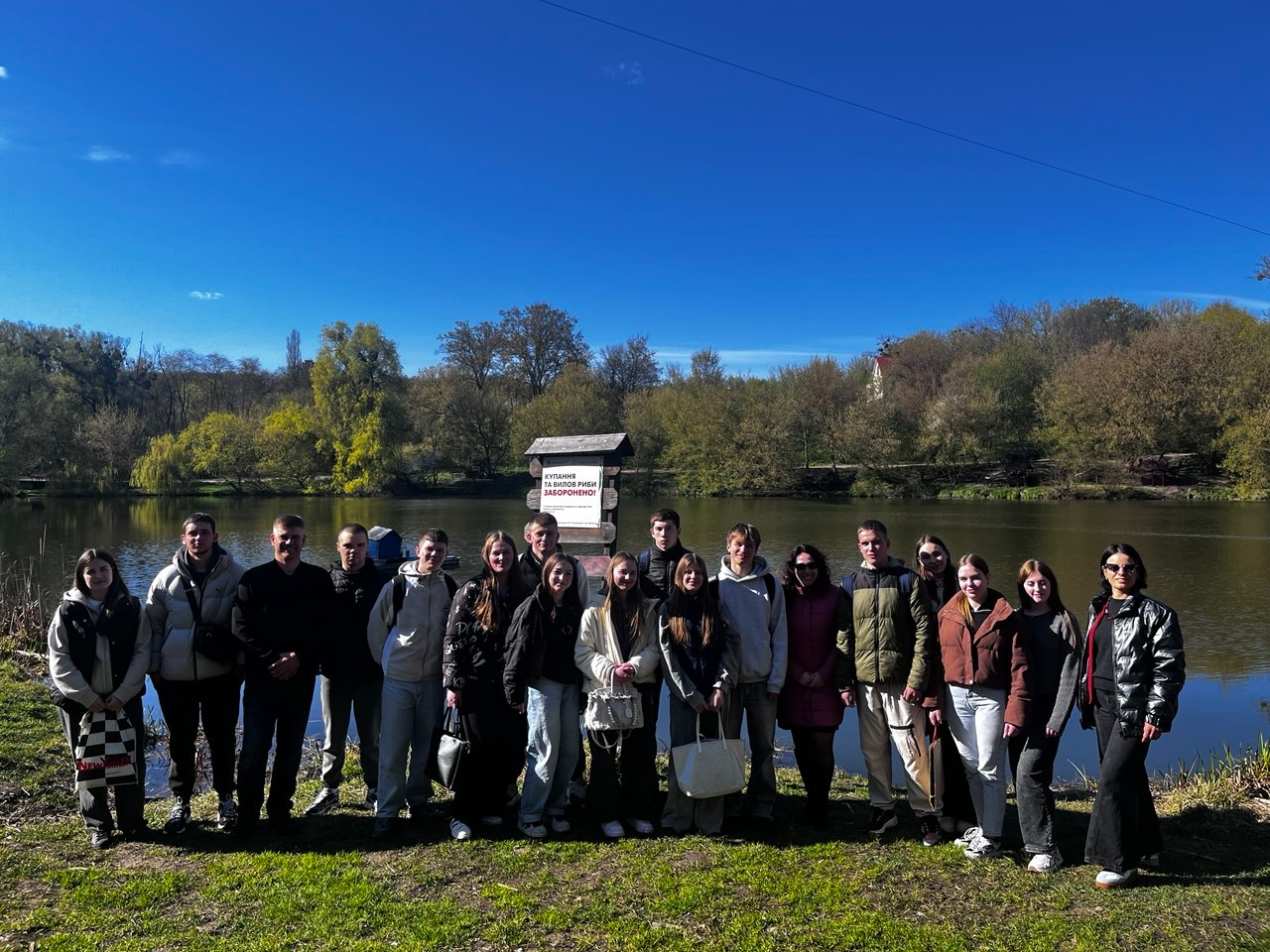
Students of the 13th group of the Agrobiological Faculty of NULES of Ukraine together with the project managers during field studies at one of the water bodies of the Holosiivskyi National Nature Park
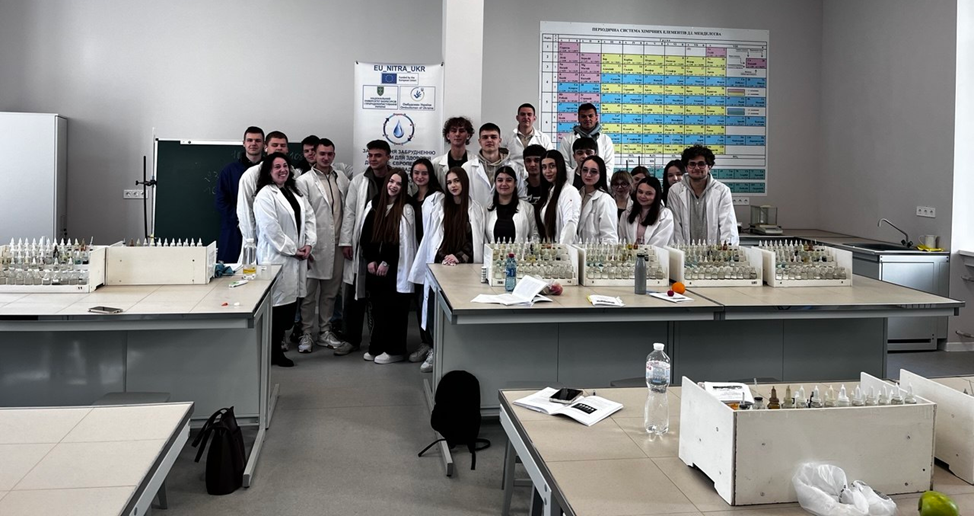
The stage of laboratory testing: project participants conduct photometric determination of nitrate content in the collected water samples to confirm the results of the field monitoring