


ReSample
RESAMPLE – FEDERATED MAPPING OF FOREST MULTIFUNCTIONALITY UNDER REDUCED SAMPLE CONDITIONS IN UKRAINE
Project: ReSample – Federated Mapping of Forest Multifunctionality under Reduced Sample Conditions in Ukraine
Funding: European Forest Institute (EFI) grant No. G-08-2025-3 under the MoniFun project (Horizon Europe No. 101134991). Call "Testing and evaluation of solutions for monitoring the state and multifunctionality of Europe's forests", Topic 2 – combining field data with Earth observation data to map forest multifunctionality indicators
Duration: 22 June 2026 – 21 June 2027 (12 months)
Budget: EUR 60,000
Coordinator: National University of Life and Environmental Sciences of Ukraine (NUBiP), Department of Forest Mensuration and Forest Management, Education and Research Institute of Forestry and Landscape Architecture
Partner: Boyarka Forest Research Station (BFRS)
Project Coordinator: Prof. Viktor Myroniuk
ReSample tests whether the European methodology for monitoring forest multifunctionality works when the field-survey network is incomplete. In Ukraine this is the case because of the war: the National Forest Inventory (NFI), launched in 2021, covers only regions that are relatively safe for fieldwork. In 2021–2023 about 6,000 sample plots were measured in 18 of 25 regions, most of them in the west of the country; 5–10 km border strips remain inaccessible even there.
The methodological basis is the European Forest Multifunctionality Monitoring System (EFMMS) developed by the MoniFun consortium. ReSample combines Ukrainian NFI data with open Earth observation data (Landsat, Sentinel-1, Sentinel-2) and applies federated learning to map forest multifunctionality indicators. The study area covers four western regions, about 57,000 km².
For the MoniFun consortium, the Ukrainian case is a robustness test of the federated learning pipeline under real data scarcity: a sparse and uneven sample, no plots in border zones, and an unequal distribution of measurements across years. If the methodology holds under these conditions, it can be transferred to other European regions with incomplete data. For Ukraine, the project is a step towards integrating the NFI into the European forest monitoring system and towards cooperation with EU countries in this field.
What is federated learning. It is a machine-learning approach in which a model is trained on data held by several participants without the data being transferred. Each participant – for example, the national forest inventory of one country – trains a local copy of the model on its own data and sends only the model parameters (weights) to a shared server. The server merges the parameters into a global model and returns it to the participants. Primary data – plot coordinates and tree measurements – never leave the owning institution. For forest inventories this is essential, since plot coordinates are confidential in most European countries. In ReSample, federated learning is implemented with the open-source Flower framework and convolutional neural networks (CNN) that predict forest attributes from satellite image time series.
Objectives
ReSample pursues three objectives aligned with the scope of MoniFun.
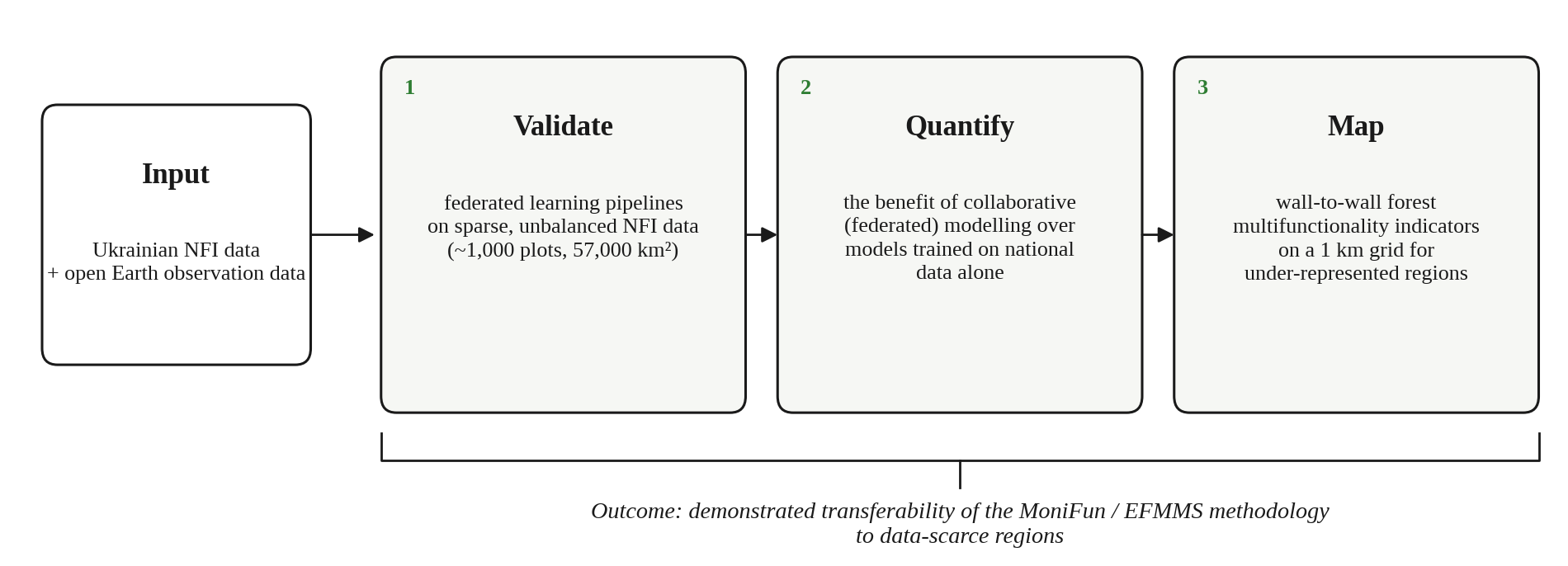
Project logic: inputs, three objectives and the expected outcome
Study area
The research covers 56,635 km² – Zakarpattia, Ivano-Frankivsk, Chernivtsi and Lviv regions, the most forested part of Ukraine. Most of the area lies in the Ukrainian Carpathians: montane forests with the highest conservation status that at the same time supply timber and other ecosystem services. Montane forests comprise beech–fir–spruce types at 200–1,100 m a.s.l. and predominantly spruce forests up to 1,700 m. The lowland part is typical of the Eastern European Plain, dominated by oak (Quercus spp.), linden (Tilia spp.), silver birch (Betula pendula) and European hornbeam (Carpinus betulus). The diversity of forests along elevation and species gradients allows federated learning to be tested across different forest types.
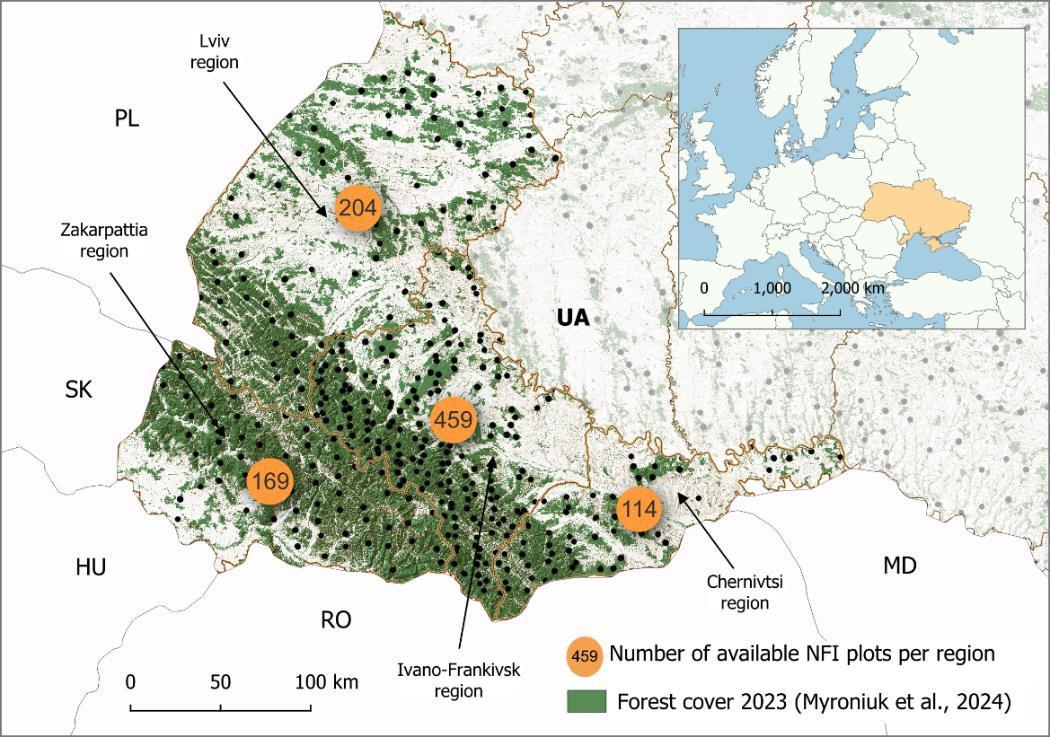
Distribution of NFI plots within the study area (from the project proposal; forest cover 2023 – Myroniuk et al., 2024)
The area was selected on three criteria: the highest density of NFI plots (about 1,000 plots measured in 2021–2023), coverage of Ukraine's main forest ecosystems, and proximity to EU countries participating in MoniFun. The Ukrainian NFI design is compatible with nFIESTA requirements: a systematic 5×5 km grid, 420×420 m clusters with four nested circular plots, and a five-year rotating panel.
Methodology and work packages
The work is organised in four work packages. Three of them (WP2–WP4) reproduce the three-step MoniFun pipeline – field data preparation, Earth observation data preparation, federated modelling. WP1 runs for the whole project and covers management, dissemination and capacity building.

ReSample data processing pipeline following the MoniFun methodology (from the project proposal)
First, data from about 1,000 NFI plots will be harmonised to the nFIESTA standard adopted by MoniFun as the common format, and target variables – growing stock, above-ground biomass, deadwood volume and stand diversity – will be calculated, with plot coordinates kept confidential. In parallel, Earth observation data – Landsat and Sentinel mosaics, terrain layers and a forest mask – will be prepared and checked for consistency with national Ukrainian products. These inputs will then be used to train federated models, compare their accuracy with models trained on Ukrainian data alone, and produce forest multifunctionality indicator maps on the INSPIRE 1 km grid. Coordination, dissemination and capacity building for Ukrainian forest monitoring institutions will run throughout the project.
What is the INSPIRE grid. INSPIRE is EU Directive 2007/2/EC establishing an infrastructure for spatial information in Europe. Among other things, it defines a standard European grid in the ETRS89-LAEA projection with 1×1 km cells. Delivering results on this grid makes maps from different countries compatible and allows plot data to be aggregated without revealing exact coordinates.
Expected outputs
- Forest multifunctionality indicator maps for western Ukraine – growing stock, above-ground biomass, deadwood, stand diversity – in open GeoTIFF format on the INSPIRE 1 km grid.
- A harmonised Ukrainian NFI dataset in nFIESTA format – a basis for further integration with European monitoring systems.
- An assessment of the benefits of the federated approach over national models, with recommendations for its use in data-scarce regions.
- Methodological guidance for the Ukrainian NFI Centre on harmonising national data with EU monitoring frameworks.
- A scientific publication, a policy brief for forest authorities (Ukrainian and English) and openly available training materials.
Events
A series of open events is planned during the project:
- webinars for NFI researchers and practitioners – nFIESTA data architecture and federated learning implementation;
- a webinar for territorial communities and forest enterprises – practical use of satellite forest monitoring and preparation for the EU Deforestation Regulation (EUDR);
- a closing conference at NUBiP with the State Forest Resources Agency, Ukrderzhlisproekt and forest research and education institutions – presentation of the methodology and discussion of aligning Ukrainian forest monitoring with EU requirements;
- a series of short training videos in Ukrainian with English subtitles and a podcast episode in English.
Announcements, registration and event materials will be published on this page.
About the European Forest Institute
The European Forest Institute (EFI) is an international organisation established by European states in 1993 in Joensuu, Finland. EFI conducts research and provides policy support on forest-related issues at the pan-European level. The Convention on EFI has been ratified by 30 states; the institute brings together about 125 member organisations from nearly 40 countries. Its headquarters are in Joensuu, with offices in Barcelona, Bonn, Brussels and Rome.
Within MoniFun, EFI manages grants to third parties – the scheme under which ReSample is funded. Call G-08-2025 aims to test the methods developed by MoniFun on independent case studies.
About the MoniFun consortium
MoniFun ("Co-creating a blueprint of a harmonised European Forest Multifunctionality Monitoring System") is a Horizon Europe project (No. 101134991, January 2024 – December 2027). It is coordinated by the Natural Resources Institute Finland (Luke) and brings together 13 partners from 11 European countries. Its goal is to co-create the blueprint for a harmonised European Forest Multifunctionality Monitoring System (EFMMS) that consolidates fragmented information on Europe's forests into a coherent, interoperable information system. EFMMS covers four thematic areas: forest resources in Europe; forests and climate change; forests and biodiversity; forests and society.
Contacts
Project Coordinator: Prof. Viktor Myroniuk, NUBiP – [email protected]
The ReSample project (EFI G-08-2025-3) is funded by the European Union through the MoniFun (Horizon Europe Project No. 101134991) grants to third parties managed by the European Forest Institute.
Funded by the European Union. Views and opinions expressed are however those of the author(s) only and do not necessarily reflect those of the European Union or the European Forest Institute. Neither the European Union nor the granting authority can be held responsible for them.
Ukrainian version about The ReSample project (EFI G-08-2025-3)