

Main research directions GeoInf&ASRE
The Department of Geoinformatics and Aerospace Research of the Earth participates in the training of specialists in geodesy and land management and promotes the mastery of modern geoinformation technologies, geospatial database technologies, automated land cadastral systems, geoinformation modeling, and technology for processing remote sensing data of the Earth (obtained on the basis of aviation, space, and ground-based sensors).
Geoinformation systems are one of the powerful technologies of the 21st century, which allows you to collect, organize, analyze, geovisualize data and justify decision-making to achieve the goals of geodesy and land management. GIS is one of the powerful tools for conducting scientific research and solving complex tasks and problems in the field of geodesy and land management using data analysis.
Approximate topics of bachelor's qualification works for applicants for higher education in specialty 193 "Geodesy and land management"
- Development of a geospatial database for planning land protection measures within the __________ community of the __________ region
- Geoinformation mapping of the suitability of land for growing main agricultural crops of the __________ community of the __________ region
- Development of a geospatial database for assessing the condition of the __________ community of the __________ region
- Evaluation of the land of the __________ community based on the use of modern geoinformation support
- Application of GIS technologies for modeling a digital relief model of the __________ community of the __________ region
- Development of a geospatial database for determining ecological and technological groups when planning crop rotations of the __________ community of the __________ region
- Analysis of the construction of a digital relief model of the __________ community of the __________ region using geoinformation systems
- Development of a geospatial database for monitoring the condition of the __________ community of the __________ region
- Determination of land plots of unauthorized landfills based on remote sensing data land surveying __________ district __________ region
- Geographical information systems as a means of controlling the use and protection of lands __________ communities __________ region
- Application of GIS technologies to increase the accuracy and objectivity of monetary valuation of lands within the community
- Development of a geoinformation system of land use __________ communities for _________
- Geocoding and vectorization of spatial objects as a basis for filling the geoinformation system with data
- Development of a database of landowners and land users
- Development and implementation of a software code for assessing the state of lands
- Geoinformation mapping of the state of lands __________ communities __________ region
- Integrated geoinformation systems in land management __________ communities to ensure sustainable development
- Application of GIS technologies for modeling a digital relief model
- Development of a geospatial database for the territory ________
- Application of GIS technologies for monitoring and protecting the environment
- Detection of changes in the agricultural landscape _____________
Approximate topics of master's qualification works for higher education applicants in the specialty G18 "Geodesy and Land Management"
- Development of a geospatial database for assessing the state of land resources
- Use of geospatial data for identification and accounting of lands under green spaces of urbanized territories
- Information technology for maintaining cadastral data
- Geoinformation monitoring of technogenically polluted lands
- Information support for rational use and protection of lands
- Methods of processing remote sensing data for monitoring lands of the nature reserve fund
- Geoinformation modeling of coastal protective and water protection zones around water bodies
- Normative monetary valuation of lands of settlements: a geoinformation approach
- Development of a geoinformation system for monitoring unauthorized landfills
- Integration of heterogeneous data for assessing the state of agronomic resources
- Geoinformation monitoring of the quality of agricultural lands basic/regional/national levels
- Geoinformation analysis of the qualitative state of agricultural lands
- Geoinformation support for land resources management of a settlement
- Information support for forest monitoring
- Geoinformation support for gas pipeline exploration and construction
- Monitoring of landfills and geoinformation modeling of their impact on environmental components
- Development of a geospatial database of the building register according to the INSPIRE specification
- Geoinformation support for monitoring degraded lands
- Study of applications of geospatial data for assessing land use in settlements
- Geoinformation mapping of soil parameters on agricultural lands
- Geoinformation analysis of agricultural landscape elements
- Geoinformation monitoring of land resources at the regional level
- Geoinformation modeling of land suitability for growing agricultural crops at the administrative district level
- Web mapping technologies for agricultural lands
Our address: 03040, Kyiv, 17 Vasylkivska St.,
academic building No. 6, room 129-132, 120, 204.
Тел.: (044) 258-0525, 258-0524
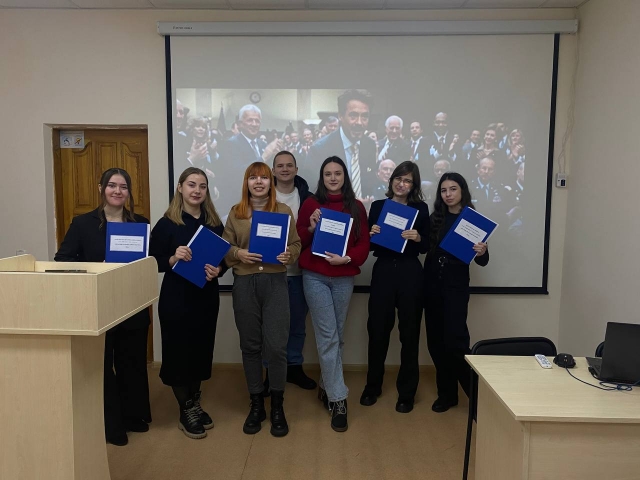
Master's degrees students - 2024