Agronomic Research Station
The Agronomic Research Station traces its origins back to the 'Mytnytsia' state farm of the Salyvinkivskyi Sugar Combine, which was organised in 1921. In 1956, pursuant to Resolution No. 524 of the Central Committee of the Communist Party of Ukraine and the Council of Ministers of the Ukrainian SSR dated 10.05.1956, and Order No. 390 of the Ministry of Higher Education of the Ukrainian SSR dated 24.05.1956 'On the Acceptance of State Farms by Agricultural Educational Institutions', the Mytnytsia state farm was transferred to the subordination of the Ukrainian Agricultural Academy as an educational and research farm. By Order No. 84 of the Ukrainian Agricultural Academy dated 23.03.1956 'On the Merger of the Mytnytsia Agronomic Research Station and the Mytnytsia Educational and Research Farm', the Agronomic Research Station was created.
Currently, 1128 hectares of land are used here, of which arable land accounts for 936 hectares. The areas of activity include scientific research, the organisation of scientific and practical placements for students, the cultivation of high-reproduction seeds of grain crops, and pedigree cattle breeding.
The village of Pshenychne is located between the villages of Kodaky and Ksaverivka. The distance to the district centre is 22 km, and to Kyiv – 56 km. As of 01.01.2014, 645 people reside in Pshenychne, and the total number of households is 234.
Mytnytsia, which was renamed to the village of Pshenychne, emerged in the 17th century after the conclusion of the 'Eternal Peace' (1686). A customs post (mytnytsia) was opened on the border between Russia and Poland, where customs duties were collected for goods imported into the territory of the Russian state. This is where the village'жвname originates. Near Mytnytsia, there are two burial mounds and one of the Zmiiev Walls (now called the Mytnytsia Wall) runs through it. For over 100 years, this wall served as the border between Russia and the lands seized by Poland.
According to the accounts of old residents, the land on which the village is situated belonged to the landowner Branitskaya until 1918. The manorial estate was entirely neglected. Out of all the lands, only 30 hectares were under crops. The rest were not cultivated due to severe waterlogging. At that time, there were only 10 homesteads in the village. In 1921, the landowner's lands were transferred to the newly established Salyvinkivskyi Sugar Factory, and this branch of it received the name 'Mytnytsia'.
Under Soviet rule, this village was located 9 km from the district centre of Vasylkiv. The population consisted of 1077 people, and it hosted the central estate of the Lenin collective farm. The collective farm had 1467 hectares of land, including 1104 hectares of arable land. Wheat, maize, vegetables, and sugar beet were grown here. Dairy farming, pig breeding, and poultry farming were well-developed. For their success in developing collective farm production, 167 individuals were awarded orders and medals of the Soviet Union, including team leader A. Soroka, who received the Order of Lenin. The village had an eight-year school, a club, and a library.
For combat merits on the fronts of the Second World War, 67 residents of the village were awarded USSR orders and medals; among them, I.S. Tonkovyd was awarded the Order of Glory of all three classes.
In March 1945, the lands were transferred to the subordination of the Korostyshiv Paper Mill and used as a subsidiary farm. In July 1949, it was transferred to the Ukrholovtsukor trust. From this time on, the subsidiary farm became a constituent part of the Salyvinkivskyi Sugar Combine of the Kyiv Sugar Trust and specialised in sugar beet cultivation. In 1954, the state farm consisted of one division. Its specialisation was beet and livestock farming.
Following its subordination to the Ukrainian Agricultural Academy as an educational and research farm in 1956, the Agronomic Research Station was created. After all the changes and upheavals, consolidations and mergers, in 1990 the village of Pshenychne was renamed in honour of Pavlo Pshenychnyi – the first rector of the Ukrainian Agricultural Academy established in 1954, and a prominent scientist in the field of zootechnics and agricultural animal feeding.
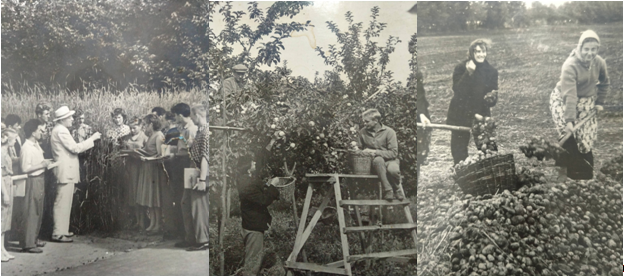
Student practice

Workers' estate and Destroyed borehole
The new base HEI was subordinated to the Union Ministry of Agriculture. The idea of creating an All-Ukrainian Agricultural Academy, born as early as the mid-1920s, was brought to life.
At the beginning of P. Pshenychnyi's tenure in Kyiv in 1957, the zootechnical faculty was opened at the educational division of the Ukrainian Academy of Agricultural Sciences on the basis of the departments of general zootechnics and agricultural animal feeding, which P. Pshenychnyi headed until 1974.
Favourable conditions for the creation of the zootechnical faculty arose in connection with the change in the status of the UAA. By the Resolution of the Council of Ministers of the Ukrainian SSR dated 30 December 1956, the Ukrainian Academy of Agricultural Sciences (UAAS) was organised under the Ministry of Agriculture of the Ukrainian SSR, which incorporated 88 research institutions, 17 research institutes, and 21 state agricultural research stations. The UAAS had 5 departments: agriculture, animal husbandry, mechanisation and electrification of agriculture, forestry, hydrotechnics and land reclamation, and economics and organisation of agriculture. The Ukrainian Agricultural Academy was also incorporated into the UAAS. By status, it functioned as an educational division. In accordance with the order of the Minister of Agriculture of the Ukrainian SSR on 2 April 1957, the Kyiv Veterinary Institute was also merged into it. Thus, the Republican Centre for Agricultural Science and Education was formed.
The newly established higher education institution was tasked with solving the following main objectives: training highly qualified specialists for agriculture who would possess deep theoretical knowledge, practical skills and abilities in their chosen profession, and be familiar with the latest achievements of domestic and foreign science, as well as continuously improving the quality of specialist training taking into account the requirements of modern production and its development prospects; organising scientific research in such a way that it contributes to the development of agriculture; creating high-quality textbooks and study guides; training academic and teaching staff; improving the qualifications of the teaching staff of higher and secondary specialised educational institutions; training managerial staff for agricultural production; improving the qualifications of agricultural specialists; physical training and implementing measures aimed at strengthening students' health, etc.
During the short period of the UAAS's existence, the academic and teaching staff of the educational division significantly intensified their scientific research and pedagogical activities. The conditions for students' practical placements improved, and the connection between science and production was strengthened. The organisation of the Mytnytsia Agronomic Research Station contributed to this.
On 4 May 1960, in accordance with the resolution of the Presidium of the UAAS, the 'Mytnytsia' Agro-Station began operating, located in the Hrebinky (now Vasylkiv) district of the Kyiv region.
Scientists solved the following tasks at the research station:
a) the economic evaluation of agrotechnical measures and the farming system; b) the development of rational tillage systems in various crop rotations of the Ukrainian Forest Steppe; c) the development of agrotechnical complexes for obtaining high yields of winter wheat, maize, sugar beet, potatoes, and other crops; d) increasing the effectiveness of organic, mineral, and microfertilisers for major agricultural crops; e) the breeding, seed production, and variety testing of winter wheat, maize, and sugar beet; f) complex mechanisation, electrification, and automation in crop farming, animal husbandry, and many others.
The 'Mytnytsia' Agro-Station, with the experienced specialist H.T. Harmatiuk appointed as its director, possessed 1721 hectares of land (1400 hectares of arable land), 399 heads of cattle, including 122 cows, 1500 pigs, and quite a large fleet of machinery (15 tractors, 20 motor vehicles, 4 combine harvesters). However, issues such as the mechanised preparation and supply of feed on livestock farms, electric milking, the cleaning of premises, the harvesting of hay and straw, and the loading and unloading of grain at warehouses and threshing floors remained unresolved.
Unfortunately, the period of the higher education institution's existence within the same structure as the Ukrainian Academy of Agricultural Sciences was brief, and the opportunities for integrating educational and scientific activities remained unutilised. Nobody provided a clear answer as to whether this decision was progressive or whether it hindered the development of education, science, and production. By the Resolution of the Central Committee of the Communist Party of Ukraine and the Council of Ministers of the Ukrainian SSR dated 4 May 1962 'On the Dissolution of the Ukrainian Academy of Agricultural Sciences and the Creation of the Agricultural Science Department within the Academy of Sciences of the Ukrainian SSR', the UAAS was dissolved, and its educational division, in accordance with the Resolution of the Council of Ministers of the USSR dated 1 July 1954, had its previous name restored – the Ukrainian Agricultural Academy. Thereafter, the UAA continued its history in an autonomous status.
With the aim of organising a base for the practical training of specialists and scientific research work, as well as exemplary farming, it was reorganised into the Agronomic Research Station in March 1966.
Subsequently, a village council was formed here in 1990. On the proposal of V.I. Kutsyi, the village was named in honour of Pavlo Pshenychnyi (12.11.1903 – 1.05.1985). The director of the farm at that time was Dmytro Baranovskyi, who also performed the duties of the village head. In 1991, Viktor Hryhorus was elected as the village head. From 2000 to 2010, the position of village head was held by Yuliia Kozak. From 2010, V.M. Hryhorus presided. In 2019, Alla Musiienko was elected as the deputy of the Kovalivka rural Amalgamated Territorial Community (ATC).
By Resolution No. 387 of the Cabinet of Ministers of Ukraine dated 01.06.1995 'On the National Agrarian University' and Order No. 157 of the Ministry of Agricultural Production of Ukraine dated 29.08.1995, the Agronomic Research Station was transferred to the direct subordination of the National Agrarian University.
The village is supplied with gas. The village has a secondary school, a kindergarten, a FOP (private entrepreneur), a House of Culture, a library, shops, and a bathhouse. Located on the territory of the village of Pshenychne is the Separate Subdivision of the National University of Life and Environmental Sciences of Ukraine 'Agronomic Research Station', which is engaged in scientific developments in the field of crop farming and animal husbandry. Approximately 20 of its former and current employees hold academic degrees.
The Agronomic Research Station is located in the village of Pshenychne, Vasylkiv district, Kyiv region. It occupies an advantageous economic and geographical position. Thus, at a distance of 3 km passes a regional highway that connects the Agro-Station with the district centre of Vasylkiv (25 km) and the regional centre, the city of Kyiv (54 km).
The first scientific curators of the station were Academicians V. Peresypkin and P. Pshenychnyi, and Professors M. Horodnii, B. Horoshkov, M. Zelenskyi, M. Diachenko, V. Moiseienko, H. Kabluchko, I. Ibatullin, and others.
Throughout the history of the Agro-Station, the following individuals have worked fruitfully in the position of director: N. Stoliar (1956), V. Dovhopol (1959), V. Kaliberda (1960), H. Harmatiuk (1960), M. Yeromenko (1961), I. Holovchenko (1963), H. Zhyvotok (1969), S. Butenko (1969), V. Kyrychenko (1973), D. Baranovskyi (1985), V. Antonenko (1993), A. Kharchuk (1996), V. Furman (1999), V. Baranovskyi (2003), O. Chornyi (2006), V. Nidselskyi (2007), H. Podpriatov (2007), P. Stashevskyi (2008), O. Karpan (2008), V. Kovalenko (2009), V. Linchuk (2012), P. Vozniuk (2013), V. Cherednichenko (2013), S. Pavliuchenko (2014), V. Zhuravel (2015), H. Bilukha (2015), V. Turynskyi (2016), S. Lychak (2016), V. Turynskyi (2016), H. Sakhatskyi (2016), V. Turynskyi (2018), S. Shpak (2018), V. Turynskyi (2018), and Yu. Rosomakha (2018 to the present).
Many scientific developments of the university's scientists have been implemented into production and yield a high economic effect. The station is engaged in the cultivation and sale of elite seeds of winter and spring grain crops and rapeseed.
Based on the scientific research conducted in the fields of the station, more than 25 doctoral and dozens of candidate's dissertations have been prepared.
The production department annually obtains high yields of agricultural crops and milk yields.
In the organisational structure of the enterprise, the largest number of employees is in animal husbandry – 33%, the motor fleet – 8%, the tractor fleet – 8%, and in crop farming – 7%. A significant number of employees are engaged in servicing within the departments. The number of managers and office workers in 2020 accounted for 9% of the total number of enterprise employees.
In the production sphere, the yield of grain crops reaches 4.8-7.0 t/ha, including maize at 10.0-13.0 t/ha. In animal husbandry, about 6000 kg of milk is milked from a single cow. New, progressive technologies for growing agricultural crops on an innovative basis are constantly being introduced into production.
The production of end-consumer products has been organised on the basis of integration with processing enterprises and the development of in-house agricultural product processing facilities.
The Agronomic Research Station is a base for the practical training of university students and teaching staff, where more than 500 people undergo educational and practical placements throughout the year.

Director